
Striping and ADA Compliance in Otay MEsa, CA
Striping & ADA Compliance in Otay Mesa, CA — Marking That Runs the Yard
On a twenty-acre drayage yard, paint isn’t decoration — it’s the operating system. Trailer position 147 either exists legibly or dispatch spends the afternoon describing it over the radio. The staging discipline either lives on the pavement or it lives in arguments. And the driver reading it all may have crossed from Tijuana an hour ago, which means the system works in numbers and symbols or it doesn’t work at all. United Paving Co provides striping & ADA compliance in Otay Mesa, CA at the district’s true scale: numbered yard systems designed for cab-height legibility, language-neutral marking for an international workforce, durability specs for the mesa’s abrasive duty — and the compliant accessible parking and routes the district’s customer-facing broker and office fronts owe the public.
The Yard as an Address System: Designing Numbers That Work
A drayage yard’s numbering is infrastructure exactly the way street addresses are — and it fails the same ways. Legibility is a physics problem first: characters read from a cab seat, at yard speed, through mesa dust and afternoon glare, need genuine size (yard-scale numerals run far larger than parking-stall stencils), placement the driver’s sightline actually crosses (entering-side orientation, not centered where a parked trailer hides it), and contrast that survives the fade cycle between repaints. Sequence is a logistics problem second: the numbering logic should mirror how dispatch and your TMS actually talk — rows and runs that increment predictably, so “147” locates itself without a map — because a system with clever zones and inconsistent jumps is a system every new driver has to be taught, and this district’s driver pool turns over daily by design. And redundancy is the honest third: paint on pavement disappears under a parked trailer — which is most of the time, at the exact positions being looked for — so mature yard systems pair pavement numerals with post- or bumper-mounted markers at the stall head, one system in two heights, findable whether the position is empty or occupied. We design numbering with your dispatch logic on the table, because the paint’s job is making your operations language physical — and the test of the finished system is beautifully simple: a driver who has never seen the yard finds position 147 on the first pass, unassisted.
Get Your Free Striping or ADA Compliance Proposal
One site walk gives you a mapped, priority-ranked plan for every sidewalk, curb, and flowline issue on the property. Call (951) 739-9200 or submit the form below.
Our Striping and ADA Services in Otay Mesa
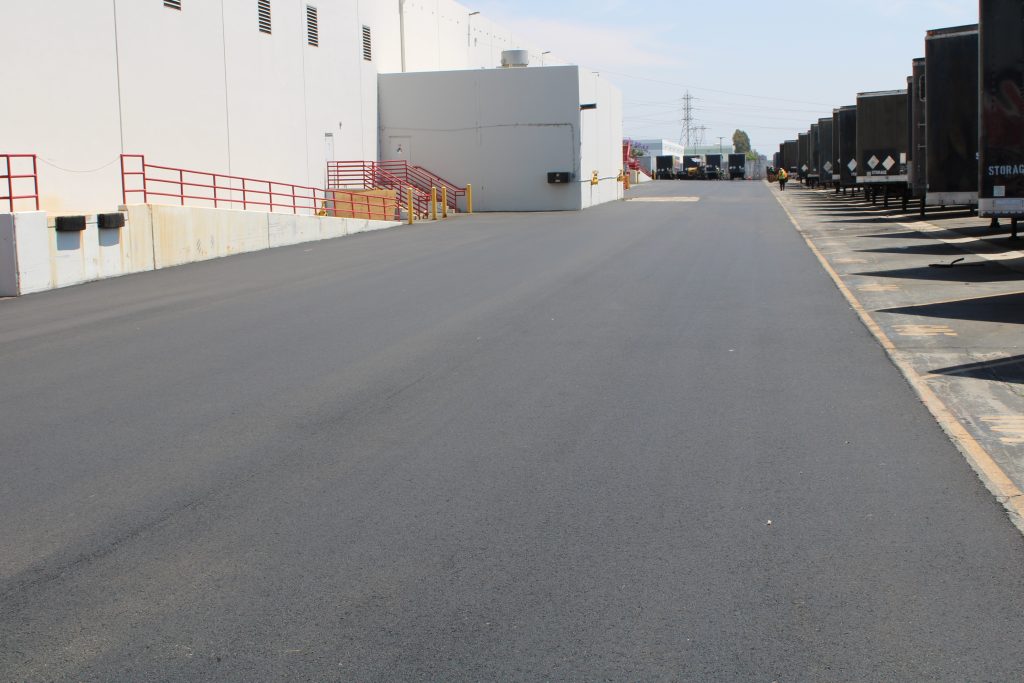
Yard Numbering & Position Systems
The mesa’s core marking work: trailer stalls, container positions, and dock doors numbered in systems designed to be operated — sequential logic that matches your TMS and dispatch language, characters sized and placed for reading from a cab seat at yard speed, and high-contrast specification that survives mesa sun and dust between repaints. A yard whose positions are legible runs on its pavement; one whose positions are guesses runs on its radio.
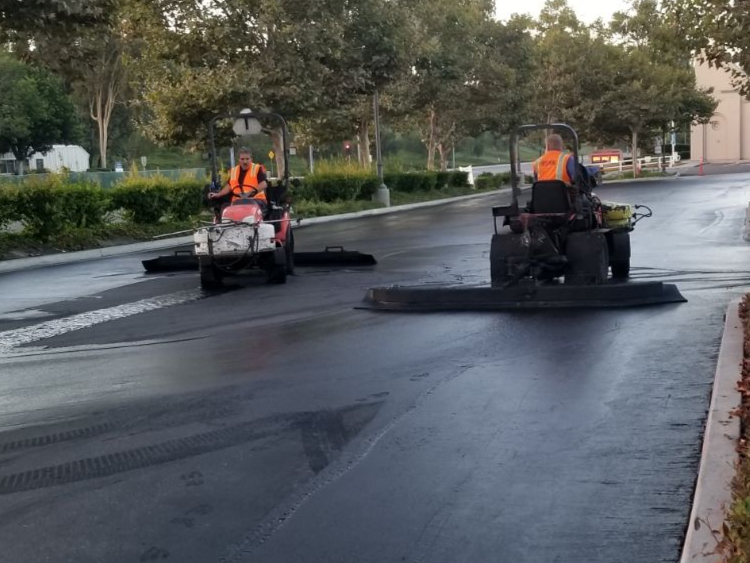
Traffic, Staging & Safety Marking
The movement layer: directional flow scaled for tractor-trailer geometry, queue and hold-position marking at gates and scales, keep-clear zones where sightlines demand them, fire-lane marking that survives full yard occupancy, and pedestrian routes wherever the district’s on-foot workforce crosses working pavement — all specified in the language-neutral conventions that make a border yard self-explanatory.

ADA Compliance for Broker Lots & Office Fronts
The customer-facing layer the district forgets it has: customs brokers, logistics offices, and will-call counters serve the public, and their lots owe accessible stalls scaled to count, van stalls with full aisles, compliant signage, and a protected accessible route to the door — engineered around the truck traffic the route must coexist with, and built to the federal standards at ADA.gov with California’s overlays.
Marking for a District: Where the Signage Can't Assume a Language
Otay Mesa’s pavement is read by the most international driver pool in California — cross-border drayage operators, long-haul drivers from both nations, day-cabs on their first and only visit — and marking that leans on English sentences fails a meaningful share of its readers on arrival. The design answer is the one traffic engineering standardized long ago: numbers, arrows, symbols, and color conventions carry the system, text carries only what convention can’t. The pavement-marking vocabulary codified in the California MUTCD — the state’s manual for traffic control devices — exists precisely because arrows and standard symbols read identically regardless of the reader’s language, and a border yard is the strongest possible case for staying inside that vocabulary: directional flow drawn, not written; positions numbered, not named; prohibitions marked in the hatching and color conventions every commercial driver on either side of the border already knows. Where text is unavoidable — safety-critical instructions at gates and scales — bilingual stenciling is the district’s honest standard, and we spec it as such. The payoff is operational, not cosmetic: every ambiguity a symbol resolves is a stopped truck that didn’t happen, and on a yard cycling hundreds of movements a day, the fluency of the pavement is measured in throughput.
Why Otay Mesa Property Owners Choose United Paving Co.
Licensed California Contractor
verify our license anytime through the CSLB license check.
Over 25 years in the asphalt and concrete industry
Serving properties from Los Angeles through San Diego County
Active members of the property-management community.
BOMA, IREM, CAI, ICSC, AGC, and more.
Materials and Methods
Free on-site written estimates
Throughout the Otay Mesa community of San Diego — 92154 (the core industrial district: the Otay Mesa Road, Airway Road, and Siempre Viva corridors and the port of entry logistics blocks), 92179 (East Otay Mesa: the SR-11 corridor parcels toward the Otay Mesa East port site), and 92173 (neighboring San Ysidro to the west) — plus the SR-905/SR-125 corridor and Ocean View Hills.
Paint on the Mesa: The Durability Math
Yard marking here lives the hardest life in the county — trailer tires scrubbing the same position lines daily, mesa dust working as ambient abrasive, and high-desert UV bleaching what the grit doesn’t grind — so the material conversation is where honest mesa striping bids separate. Standard traffic paint remains right for the lower-abuse layers (office lots, perimeter marking) and for systems young enough to still be evolving, on a 1–2 year refresh reality for the working zones. High-build paints and preformed materials earn their premium at the punishment points — position numerals, gate and queue lines, fire lanes — where repaint frequency becomes its own cost and a thicker system halves the cycle. And the compliance-critical marks hold the shortest leash regardless of material: accessible stalls and aisles, keep-clears, and fire lanes are re-marked at first legibility loss, because a faded ADA aisle is a violation in ghost paint and a buried fire lane is a finding waiting for an inspection. The scheduling economics mirror the mesa’s other surfaces: repaints bundled with seal-coat cycles get their erase-and-redraw moment free (see [Seal Coating in Otay Mesa] — internal link), overnight execution keeps the yard’s positions in service through the border’s respiration, and every cycle is the zero-cost window to fix what the last layout got wrong — which, on yards that grew position-by-position as the district boomed, is usually the numbering system itself.
Otay Mesa Striping and ADA Compliance - FAQs
Our yard's numbering grew over the years and nobody can find anything. Where do we start?
With the dispatch language, not the paint: map how your TMS and radio traffic actually reference positions, design a sequence that matches it, and repaint to the new system in one coordinated cycle — with a short dual-marked transition if operations can't pause. The paint is the easy half; the logic is the project.
What size should position numbers actually be?
Sized to the reading task: a driver at cab height, moving at yard speed, at the distance your rows actually present — which lands yard numerals at several times parking-stall stencil size, oriented to the approach direction. If your current numbers were sized like stall numbers, that's the legibility gap drivers keep reporting as "confusing yard."
How do we mark positions that are hidden when trailers park on them?
Two heights, one system: pavement numerals for the empty-stall case, post- or bumper-mounted markers at the stall head for the occupied case. A yard findable only when it's empty is findable exactly when nobody's looking for anything.
Do our broker office and will-call lots really carry full ADA obligations in an industrial district?
Fully — public access sets the obligation, not the zoning: accessible stalls scaled to count, a van stall with its aisle, compliant signage, and a protected route to the counter that doesn't send anyone through live truck traffic. It's the district's most common compliance gap, and among its cheapest to close during a scheduled repaint.
English-only markings — are they actually a problem, or just impolite?
Operationally real: a meaningful share of this district's daily drivers read the pavement better in symbols and numbers than in English sentences, and every misread instruction is a stopped truck. Symbol-first design plus bilingual stenciling at the safety-critical points isn't courtesy — it's throughput engineering.
Can a full yard renumbering happen without stopping operations?
Yes — sectioned overnight cycles with dual marking through the transition, sequenced with dispatch so every active row stays referenced every shift, and the compliance-critical marks (fire lanes, accessible stalls) never offline. The cutover plan ships with the proposal, dates included.
Areas We Serve NEAR Otay MEsa
We work throughout the Otay Mesa community of San Diego — 92154 (the core industrial district: the Otay Mesa Road, Airway Road, and Siempre Viva corridors and the port of entry logistics blocks), 92179 (East Otay Mesa: the SR-11 corridor parcels toward the Otay Mesa East port site), and 92173 (neighboring San Ysidro to the west) — plus the SR-905/SR-125 corridor and Ocean View Hills. See our striping pages for Miramar, Carlsbad, and Vista.