
Striping and ADA Compliance in Vista, CA
Truck Courts, Safety Markings & Accessible Routes
In Vista’s business parks, the pavement isn’t just parking — it’s a workplace. Forklifts cross the same yard employees walk. Trailers stage in courts that fire apparatus must still penetrate. Visitors to a manufacturer’s front office need an accessible route through an environment built for freight. United Paving Co provides striping and ADA compliance in Vista, CA for exactly this reality: layout and markings that organize working industrial sites safely — dock and trailer stall numbering, pedestrian/vehicle separation, fire lanes, and the ADA stalls and routes every site owes its public — alongside conventional striping for the city’s retail, office, multi-family, and HOA properties.
The 15-Minute Self-Audit: Walk Your Own Lot Before Anyone Else Does
You don’t need a consultant to find your lot’s most common compliance gaps — you need a tape measure, a smartphone, and this list. Count your stalls, then your accessible stalls: the federal baseline scales from 1 accessible per 25 total, and the full table is published in the 2010 ADA Standards — if your lot has grown or been re-striped since the last count, the math may have moved without you. Find the van stall: at least one accessible stall must be van-accessible with its wider aisle and “van accessible” signage; older layouts miss this category entirely. Inspect the access aisles: full-width, fully hatched, and physically unusable for parking — an aisle a car can occupy is a violation in waiting. Check the signs, not just the paint: each accessible stall needs its vertical sign at compliant mounting height; paint-only marking fails, and California adds its own signage requirements on top. Test the slope with your phone: a level app on the stall and aisle surface tells you instantly if you’re near the strict maximums — the failure paint can’t reveal and only pavement can fix. Walk the route: roll anything with wheels from the accessible stall to your entrance; every abrupt lip, steep segment, or stretch through active vehicle traffic is a gap in the chain. Photograph everything as you go — either it becomes your punch list for the next re-stripe, or it becomes the documentation that shows good faith.
What this self-audit can’t do is certify you: formal compliance review in California is the Certified Access Specialist’s role, and findings that involve slope, ramps, or routing need construction to fix. But owners who walk this list find most of what a demand letter would have found — at tape-measure cost instead of legal cost.
Get Your Free Striping or ADA Compliance Proposal
One site walk gives you a mapped, priority-ranked plan for every sidewalk, curb, and flowline issue on the property. Call (951) 739-9200 or submit the form below.
Our Striping & ADA Services in Vista
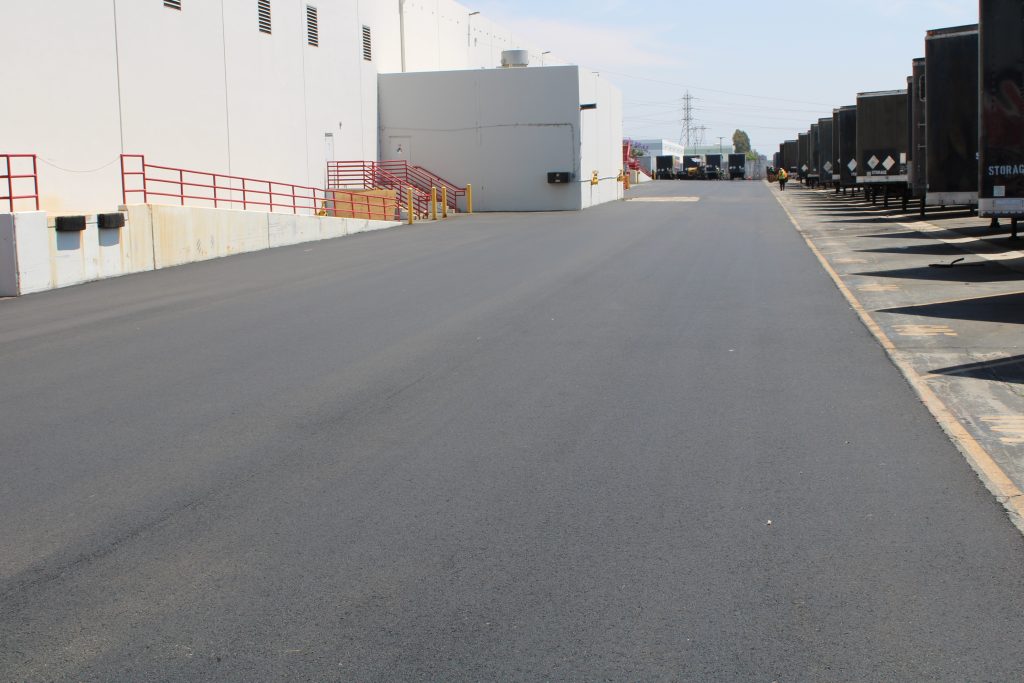
Truck Court & Yard Marking
The industrial core of Vista’s striping demand: numbered dock positions and trailer stalls that make yard management legible, staging and no-park zones at gates and scales, directional flow for tractor-trailers whose turning geometry forgives nothing, and high-visibility marking specified for surfaces that take abrasion ordinary lots never see.
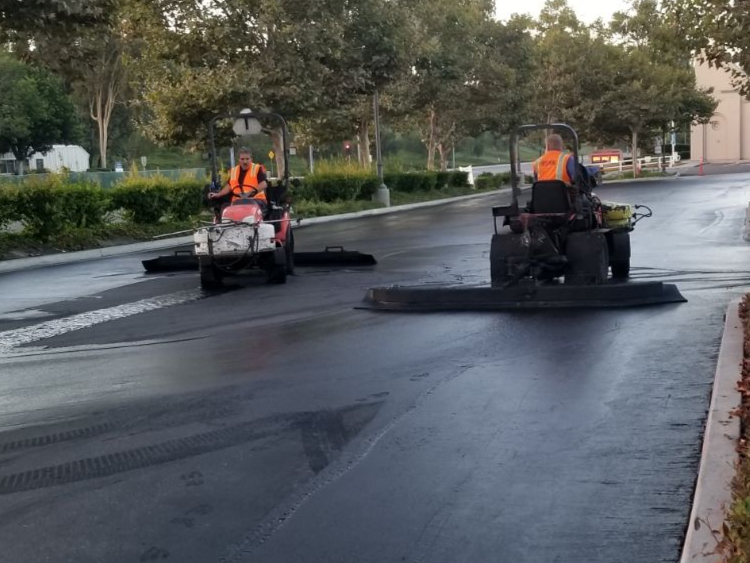
Pedestrian & Forklift Separation Systems
Marked walking routes through working yards — high-visibility pedestrian lanes, crossing points at controlled locations, and keep-clear zones at doorways where a person and a forklift would otherwise meet blind. Separating foot and vehicle traffic is bedrock workplace-safety practice — OSHA’s walking-working surfaces requirements govern the broader obligation — and on an industrial exterior, paint and layout are how that separation physically exists.
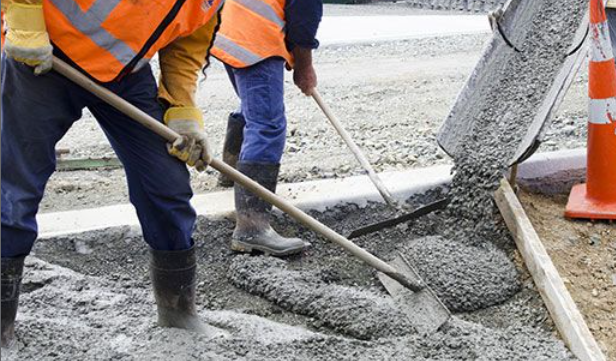
ADA Compliance & Site Striping
Accessible stalls, aisles, signage, and the connected route to the entrance — engineered for industrial sites where the accessible path must coexist with truck traffic — plus the conventional full-lot scope: stall layout and re-striping, fire lanes to fire-authority requirements, EV and loading zones, crosswalks, and stenciling, for every property type from Paseo Santa Fe storefronts to Shadowridge HOA streets.
ADA at the Industrial Front Door
Industrial doesn’t mean exempt. A manufacturer’s front office, a brewery’s tasting room, a distributor’s will-call counter — each owes the public accessible parking and an accessible route under the federal standards at ADA.gov, and California’s stricter overlays apply here as everywhere. The industrial complication is routing: the accessible path from stall to entrance has to be engineered around truck movements, not painted through them, and stall placement near office entrances has to respect slope limits on pavement often graded for drainage first. We design the accessible system into the working layout — and when the site seals or repaves, the erase-everything moment is when corrections cost nothing extra (see [Seal Coating in Vista].
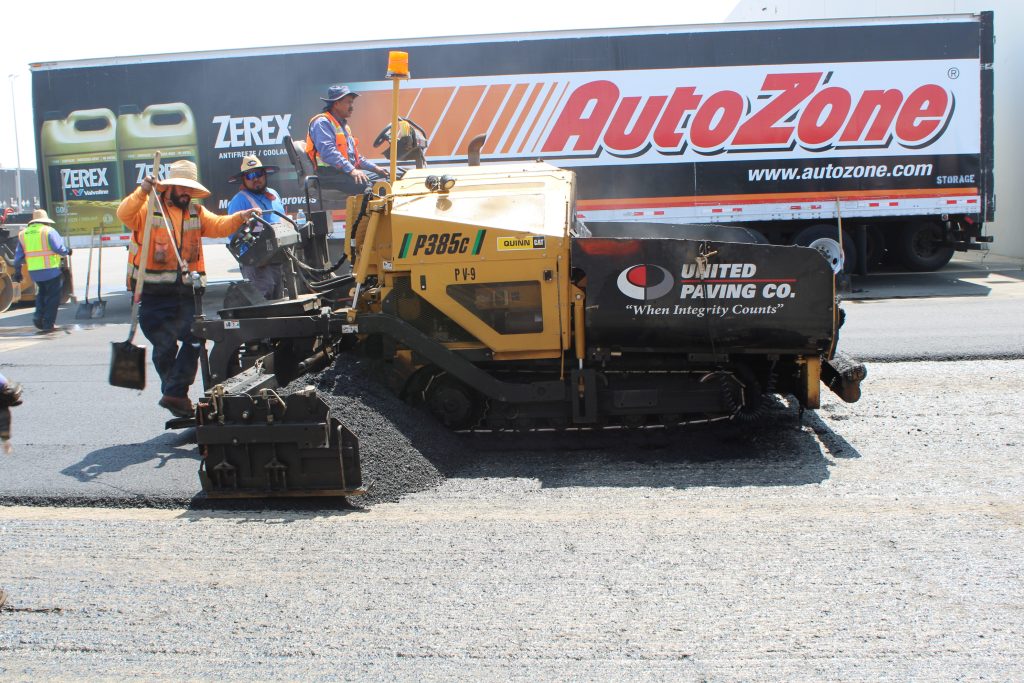
Why Escodido Property Owners Choose United Paving Co.
Licensed California Contractor
verify our license anytime through the CSLB license check.
Over 25 years in the asphalt and concrete industry
Serving properties from Los Angeles through San Diego County
Active members of the property-management community.
BOMA, IREM, CAI, ICSC, AGC, and more.
Materials and Methods
Free on-site written estimates
Throughout Vista — 92081 (South Vista: Shadowridge and the Sycamore Avenue/Palomar business park corridor), 92083 (West Vista: the Townsite neighborhoods and South Santa Fe corridor), and 92084 (North and East Vista: downtown, Vista Village, and the foothill neighborhoods).
The Language of Pavement Marking: What the Colors and Lines Mean
Striping is a code, and knowing it lets you read your own property — and your neighbors’ — like an inspector. Red is fire access: curbs and lanes where parking is prohibited because apparatus needs the space, marked and signed to fire-authority requirements, enforceable by citation and tow. Blue is accessibility: stall markings and the access aisles beside them — and an aisle’s diagonal hatching means never park or stage here, including “just for a minute” with a delivery. Yellow carries the caution family: pedestrian lanes and crossings, keep-clear boxes at blind doors, speed humps, and physical-hazard marking — in a working yard, yellow is where feet are protected from machines. White does the organizing: parking stalls, directional arrows, stall numbers, and lettering.
Two practical implications follow. First, color misuse creates real problems — a faded red curb still carries legal force, while an improvised “red-ish” zone painted without fire-authority coordination can create enforcement confusion in both directions. Second, on industrial sites the code is a safety system, not decoration: a driver from any company, on any shift, reads a yellow crossing or a hatched keep-clear the same way, which is exactly why the conventions exist.
Vista Striping and ADA Compliance - FAQs
What should a truck court's marking package actually include?
Numbered dock and trailer positions, staging and keep-clear zones, directional flow arrows scaled for tractor-trailer geometry, fire lane marking that survives full yard occupancy, and pedestrian routes wherever people walk the yard. If your current court has paint but no system, the repaint is the moment to fix that.
Are marked pedestrian lanes in an exterior yard actually required?
The obligation is to control the pedestrian/vehicle hazard, and marked separation is the recognized way exterior yards do it — it's the same principle OSHA applies to walking-working surfaces generally. Beyond compliance, it's the cheapest incident-prevention on the property, and insurers notice it.
Our accessible stalls are near the office but trucks cross the route. Is that compliant?
Probably not as-is — the accessible route must be usable, and a path through active truck traffic fails that test in practice. The fix is routing: stall placement and a marked, protected path designed around the yard's vehicle movements. It's a layout problem before it's a paint problem, and we solve it in that order.
How often does yard striping need repainting versus regular lot striping?
Faster — abrasion from trailer tires, forklifts, and yard trucks wears marking that would last years on a retail lot. Plan high-traffic yard marking on a 1–2 year refresh, with high-build or preformed materials as the upgrade path where repaint frequency becomes its own cost.
Can striping happen while the yard operates?
Yes — zone by zone, sequenced with your shift and dock schedule, with dry times managed so a section returns to service the same day. Yard marking projects are phasing exercises as much as painting ones, and the phasing is our scope.
Who verifies our stall counts and signage are current?
We audit layout against the current federal and California requirements as part of every striping proposal — counts, van stalls, aisles, signage, slopes — and for owners who want the formal legal review, we work from CASp inspection reports and execute their corrections routinely.
Areas We Serve NEAR Vista
We work throughout Vista — 92081 (South Vista: Shadowridge and the Sycamore Avenue/Palomar business park corridor), 92083 (West Vista: the Townsite neighborhoods and South Santa Fe corridor), and 92084 (North and East Vista: downtown, Vista Village, and the foothill neighborhoods). See our striping pages for San Marcos, Carlsbad, and Escondido.