
Striping and ADA Compliance in Miramar, CA
Striping & ADA Compliance — Queue Design for Properties Where Customers Meet the Shop
Miramar’s defining striping problem exists almost nowhere else at this density: properties where the public drives into a working operation. An auto-service customer pulls into the same pavement where techs move cars and parts trucks stage; a will-call visitor threads a distribution yard; a fleet client walks a working lot to sign paperwork. United Paving Co provides striping & ADA compliance in Miramar, CA for exactly that collision of audiences — service-queue design that converts morning chaos into throughput, marking that separates customer flow from shop flow, and the accessible stalls and routes that customer-facing businesses owe every visitor, working environment or not.
Queue Science: The Geometry of a Morning Rush
A service business’s queue is a machine, and like any machine it has design parameters worth knowing — because on this corridor, the queue is the storefront: it’s the first thing every customer operates, and it sets the tone for the transaction before a human says a word.
Stacking depth is the first parameter, and the mistake is designing to the average. Count the vehicles your worst normal morning delivers in the fifteen minutes after opening — the Monday-after-a-holiday number, not the Tuesday-afternoon one — because a queue holds or it doesn’t, and the day it doesn’t, the overflow lands on Miramar Road as a traffic complaint with your name on it. Depth also has a shape component the paint controls: angled queue positions stack more vehicles per linear foot than straight-in lines on many lot geometries, and the marking layout is where that arithmetic gets solved.
Position clarity is the second: each queue slot marked, the front position unambiguous, and the handoff point — where customer becomes service writer’s problem — drawn on the pavement rather than negotiated through windshields. Every unmarked decision gets improvised, and improvisation at 7:30 AM means gaps that waste stacking depth, straddled lanes, and the daily standoff where two vehicles both believe they’re next. Numbers or letters on the positions pay a bonus most owners don’t anticipate: “you’re vehicle three, about twenty minutes” is a customer-service sentence the pavement makes possible.
The escape lane is the most underrated parameter: a marked path out of the queue for the customer in the wrong line, the one who changed their mind, or the one who just needs the parts counter. Without it, one confused vehicle constipates the entire intake while everyone behind performs a nine-point turn in sequence; with it, wrong turns cost seconds. If your queue has ever gridlocked because of a single car, this is the missing line.
Drop-off choreography rounds it out — and it’s really two flows sharing a lot. After-hours key-drop parking belongs where dropped vehicles don’t block the morning’s queue formation, which is exactly where customers park them when no marking says otherwise: nearest the door, in the queue’s throat. Pickup staging runs the mirror problem — completed cars positioned so departures never cross the intake stream, because the outbound customer and the inbound one meeting head-on in a drive aisle is the corridor’s most repeated fender-bender.
None of this requires more pavement — it requires the pavement you have making decisions in paint instead of leaving them to whoever arrived most confident. The audit costs one cup of coffee: walk your lot at opening time and count the improvised negotiations — hesitations, straddles, windshield diplomacy. Each one is a marking gap, and the layout that fixes them is a morning’s paint.
Get Your Free Striping or ADA Compliance Proposal
One site walk gives you a mapped, priority-ranked plan for every sidewalk, curb, and flowline issue on the property. Call (951) 739-9200 or submit the form below.
Our Striping and ADA Services in Miramar
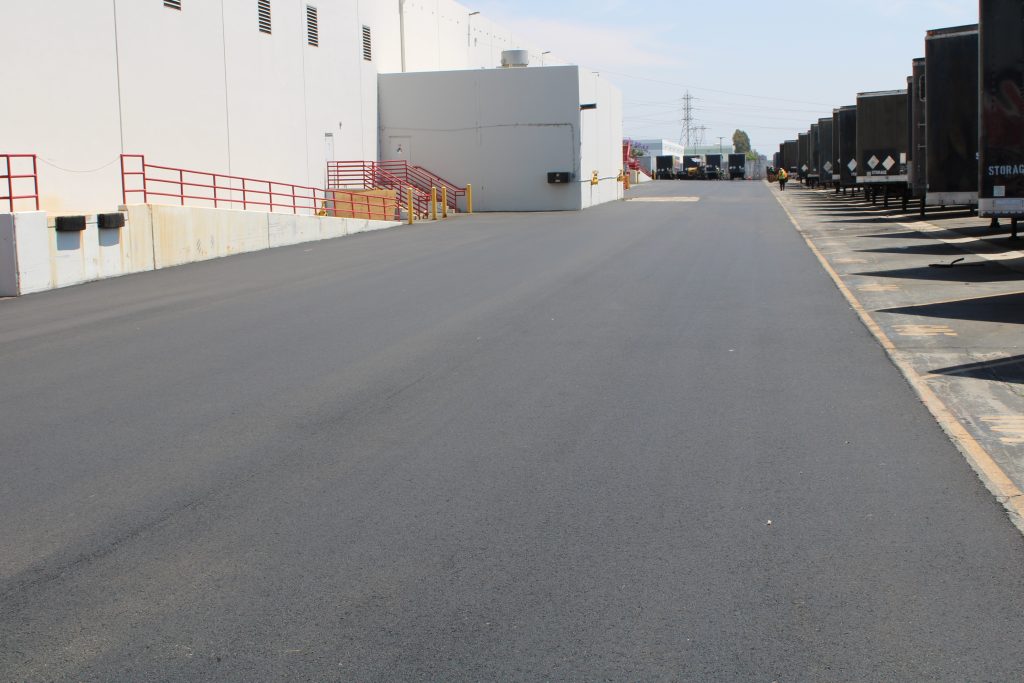
Service-Queue Design & Marking
The auto-row specialty: intake queues designed for real stacking depth, drop-off and key-drop positions marked where the workflow actually wants them, escape lanes so a wrong-turn customer isn’t trapped mid-queue, and directional flow that gets the 7:30 AM rush from street to service writer without a single improvised decision.
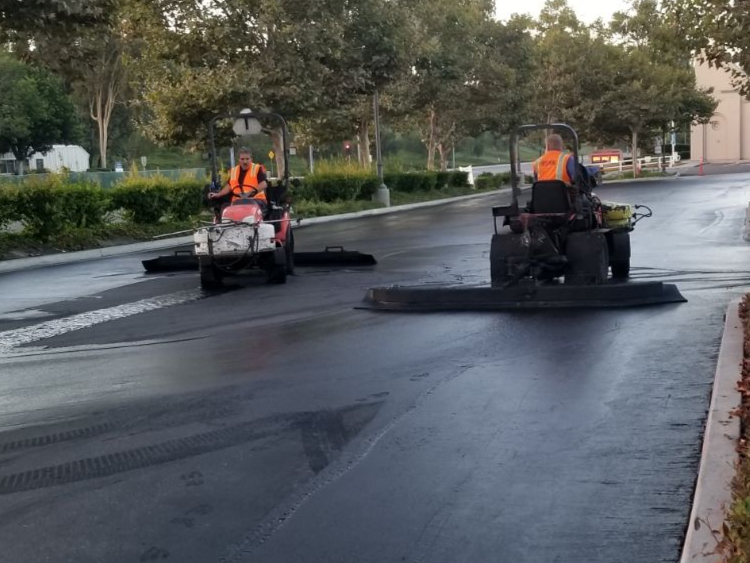
Customer / Shop Traffic Separation
Marking that gives each audience its own pavement: customer paths and parking distinguished from shop movements and staging, keep-clear zones at bay doors and blind corners where a visitor and a moving vehicle would otherwise negotiate in real time, and the visual clarity that lets first-time customers self-navigate a property that’s simultaneously a workplace.
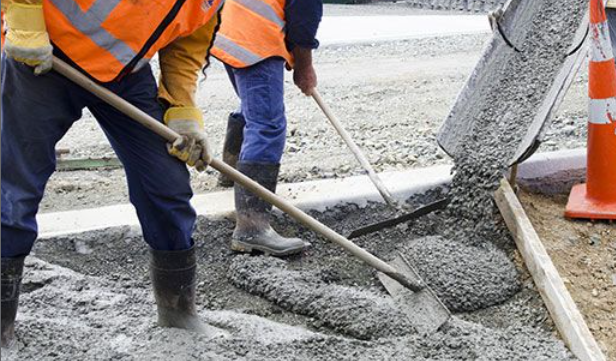
ADA Compliance for Customer-Facing Industrial
Accessible stalls scaled to count requirements, van stalls with full aisles, compliant signage, and — the corridor’s recurring gap — the accessible route: a protected, compliant path from stall to service counter or will-call window through an environment of driveways and vehicle movement, built to the federal standards at ADA.gov with California’s overlays, and coordinated with the frontage’s physical path (see [Sidewalks, Curbs & Gutters in Miramar]
Two Audiences, One Lot: Separation Without a Wall
The corridor’s properties can’t fence customers away from operations — the business model is the public entering the shop’s world — so separation happens in marking, and it runs on three principles. Distinct visual languages: customer areas marked in conventional lot vocabulary (standard stalls, clear directional arrows) while shop zones carry work-zone vocabulary (staging boxes, keep-clear hatching, no-public stenciling) — so each audience recognizes its territory without reading a manual. Protected crossings, not shared ambiguity: where customer paths must cross shop movements — and on a service property they must — the crossing is marked as an event: high-visibility, positioned at sightlines, one location instead of everywhere. The counter route as spine: the walk from customer parking to the point of sale is the property’s most traveled pedestrian path and its accessibility obligation in physical form — so it gets designed first, protected best, and kept compliant, with the accessible version of that route (slope-checked, lip-free, signed) treated as the route, not a parallel afterthought. This is where Miramar differs from a closed industrial yard: the design isn’t protecting trained employees who know the environment — it’s protecting first-time visitors who don’t, which is a stricter standard and a paint-cheap one to meet.
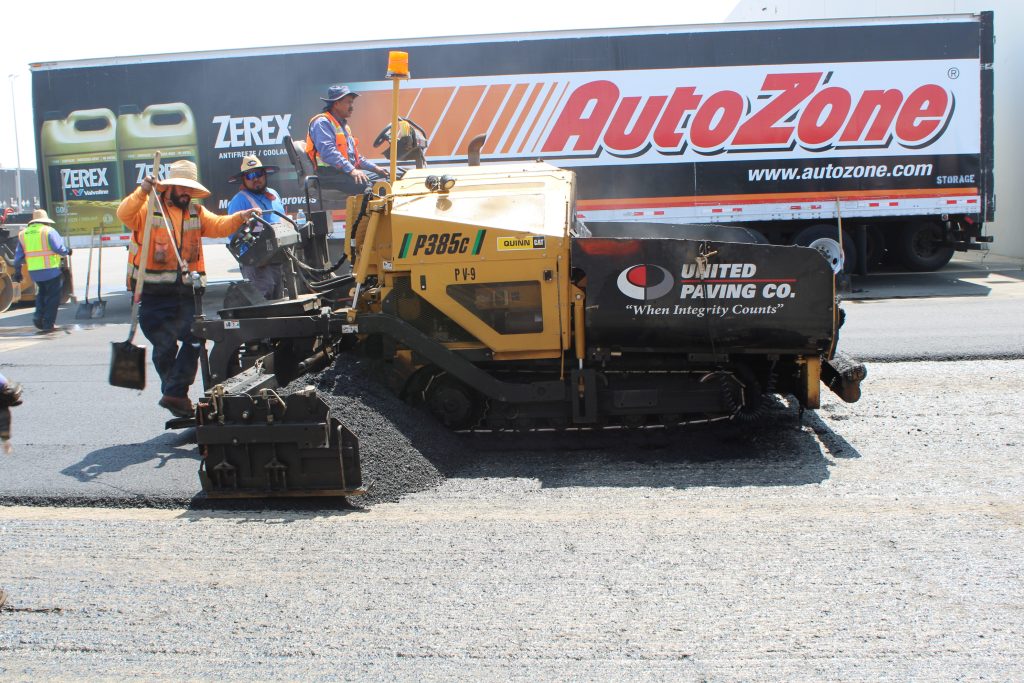
Why Miramar Property Owners Choose United Paving Co.
Licensed California Contractor
verify our license anytime through the CSLB license check.
Over 25 years in the asphalt and concrete industry
Serving properties from Los Angeles through San Diego County
Active members of the property-management community.
BOMA, IREM, CAI, ICSC, AGC, and more.
Materials and Methods
Free on-site written estimates
We work throughout the Miramar community of San Diego — 92126 (the Miramar Road industrial corridor and adjacent Mira Mesa) and 92121 (the western industrial blocks toward Sorrento Valley and Sorrento Mesa) — plus the neighboring Kearny Mesa and Scripps Ranch business areas.
Repaint Discipline on a Hard-Working Corridor
Marking on this corridor lives a hard life — service-queue lanes scrubbed by all-day creep-and-turn traffic, shop-zone stenciling ground under staging movements, fluid exposure staining lines that abrasion hasn’t yet erased — so Miramar repaint cycles run short: high-traffic queue and crossing markings realistically every 1–2 years, with the compliance-critical marks (accessible stalls, aisles, keep-clears) held legible on the shortest cycle of all, since a faded ADA aisle is a violation drawn in ghost paint. The economics favor bundling: repaint scheduled with seal-coat cycles gets the erase-and-redraw moment for free (see [Seal Coating in Miramar], overnight application keeps the queue open for the morning it serves, and every cycle is the zero-cost window to correct what the last layout got wrong — which, on lots striped before their business model matured, is usually the queue itself.
Miramar Striping and ADA Compliance - FAQs
Our morning intake is chaos but we don't have room to add queue space. Now what?
Depth isn't the only lever — clarity and flow recover more capacity than owners expect: marked positions eliminate the gaps improvisation leaves, an escape lane stops single-vehicle blockages, and separating pickup flow from intake flow often frees pavement the chaos was consuming. We redesign within your existing footprint first; more pavement is the last resort, not the first.
Customers keep parking in our shop staging areas. Is that a signage problem or a striping problem?
Both, solved together: staging marked in work-zone vocabulary (hatching, stenciled no-public messaging) reads as off-limits in a way an unmarked rectangle never will, and customer parking made obviously easier to find removes the reason to improvise. People park where the pavement invites them; redraw the invitation.
Where does our accessible stall belong — near the counter or away from the shop traffic?
Both, by design: the standard wants the accessible stall on the shortest accessible route to the entrance, and the working environment demands that route be protected — so placement is solved as one problem: stall positioned close, route threaded and marked away from bay doors and queue crossings, slopes verified where drainage grading complicates it. If your current stall is close but its route crosses live shop traffic, it's compliant on paper and failing in practice.
Do fleet clients and will-call visitors change our ADA obligations versus retail customers?
No discount applies — public access is public access, whether the visitor buys a part, signs a fleet contract, or picks up a vehicle. The accessible stall, aisle, signage, and route obligations follow the customer-facing function of the property, and the corridor's most common gap is exactly there: businesses that modernized their counters and never re-examined the pavement route to them.
How fast does queue marking wear compared to our regular stalls?
Multiples faster — queue lanes take slow-rolling, turning, all-day traffic on the same paint stripe, which is the hardest duty marking faces. Budget queue and crossing marks on a 1–2 year refresh against the stalls' longer cycle, or step those zones up to high-build materials where the repaint frequency becomes its own cost.
Can you restripe without shutting down a day of service appointments?
Overnight is the corridor standard: queue and customer zones painted after close, dry and open for the morning rush, shop zones sequenced around your staging needs, and the compliance-critical marks done first so the property is never operating without them. The service writer's morning should start with fresh lines, not cones.
Areas We Serve NEAR Miramar
We work throughout the Miramar community of San Diego — 92126 (the Miramar Road industrial corridor and adjacent Mira Mesa) and 92121 (the western industrial blocks toward Sorrento Valley and Sorrento Mesa) — plus the neighboring Kearny Mesa and Scripps Ranch business areas. See our striping pages for Otay Mesa, Carlsbad, and Vista.