
Asphalt Paving in Miramar, CA
Asphalt Paving — Built for the Corridor That Never Stops
Miramar isn’t a city — it’s an engine room. This community of San Diego, stretched along the Miramar Road corridor between I-805 and I-15 in the shadow of MCAS Miramar, packs one of the county’s densest concentrations of warehouses, distribution operations, fleet yards, and the famous auto-service row into pavement that works around the clock. United Paving Co provides asphalt paving in Miramar, CA for exactly that duty: new construction, removal and replacement, and fine grading engineered for throughput — and delivered through the City of San Diego’s Development Services permit machine, which we navigate so you don’t have to learn it.
The Frequency Problem: Why Miramar Pavement Ages in Fast-Forward
Pavement engineers think in load cycles, and Miramar runs the meter like nowhere else in this project. The industry’s design math converts every vehicle into standardized axle passes, and the totals here are lopsided twice over: a quiet suburban lot might log a few hundred meaningful passes a day and rest all night, while a Miramar fleet gate or auto-row driveway takes thousands, across extended hours, seven days a week. And the passes aren’t equal — axle damage rises exponentially with weight, so one loaded box truck fatigues pavement like a long parade of sedans, and this corridor runs both at volume.
The second half of the problem is rest: asphalt is viscoelastic, deflecting microscopically under each axle and recovering in the quiet between loads — but recovery takes time the corridor doesn’t grant, so fatigue accumulates at multiples of the suburban rate, and the surface shows it as fine alligator cracking along the shared travel paths years before the stalls beside them age at all. The design translation: Miramar sections are specified to cycle counts, not lot size — deeper base and thicker asphalt in gates, aisles, and approach lanes; honest mix selection where turning traffic works the surface; concrete at the true punishment points (see [Concrete Installation & Repair in Miramar]. The budgeting translation matters just as much: a Miramar lot built to a suburban spec isn’t cheaper — it’s a shorter subscription, renewing at demolition prices.
Get Your Free Asphalt Paving Proposal
Our estimating and project management team will develop the right scope of work for your budget, performance goals, and visual expectations. Estimates and recommendations are free. Call (951) 739-9200 or submit the form below.
Your Pavement Maintenance Timeline
| When | What | Why |
|---|---|---|
| Year 1 | First seal coat (after full cure) | Locks in binder before UV oxidation starts |
| Every 3–5 years | Re-apply seal coat | Ongoing UV and moisture protection in our high-sun climate |
| Annually (fall) | Crack sealing | Closes entry points before winter rains reach the base |
| As needed | Patching, striping refresh | Addresses isolated damage; maintains ADA compliance |
| Year 15–25+ | Overlay or reconstruction | Even well-maintained pavement eventually reaches structural end-of-life |
Anatomy of a Throughput Lot: Where the Money Should Go
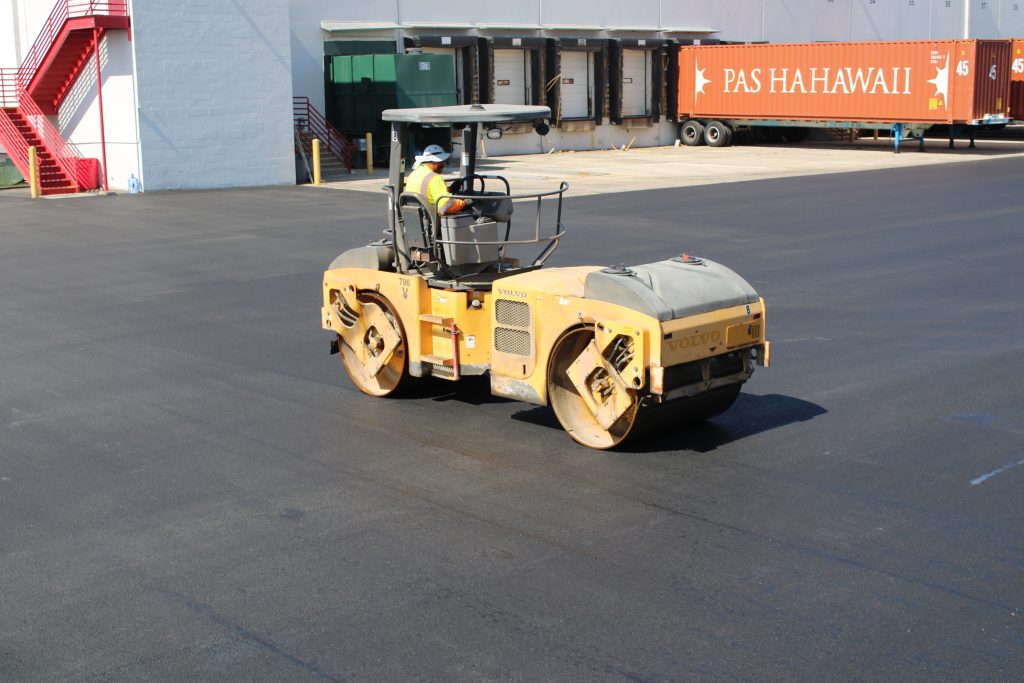
Walk any hard-working Miramar property and its pavement budget should map to four zones, in descending order of duty. The gate and approach throat takes every vehicle the property ever hosts — the highest cycle count on the site, always the heaviest section, and the worst possible place to economize, because a failed gate taxes every movement behind it. The spine aisles — the main circulation everything shares — carry the second-highest counts and earn the second-heaviest section; this is where fatigue alligatoring shows first on under-built lots. Working zones — dock faces, service queues, staging — carry heavy loads at low speed with turning stress, arguing for stiff mixes or concrete at the extremes. The stall fields carry the least duty on the property and can be built economically without sin — which is precisely the point of zoned design: money moved from the stalls to the gate buys decades where it matters at little added total cost. A proposal that prices all four zones identically hasn’t read the property; ours states each zone’s section on paper, so you can see where every dollar of asphalt is standing.
Our Asphalt Paving Services In miramar
New Construction for Throughput Properties
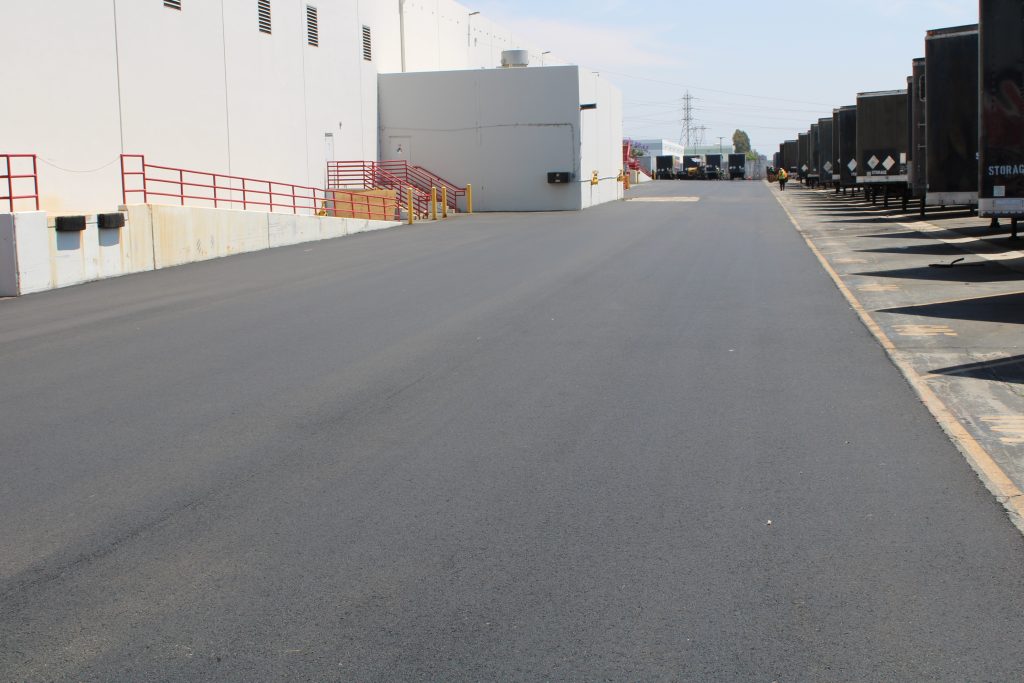
Ground-up paving for warehouse yards, fleet lots, auto-service properties, and the corridor’s mixed commercial sites — sections designed from the traffic’s frequency as much as its weight, because Miramar pavement rarely gets the overnight rest that lets most asphalt recover. Written specs on every proposal: thickness, base, mix, and fiber-reinforced (Forti-Fi) options for the lanes that never go quiet.
Removal & Replacement Without Killing the Uptime
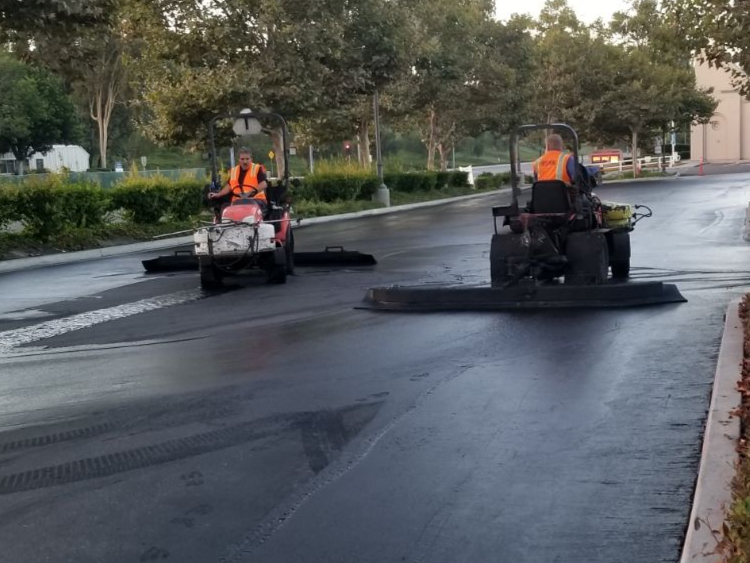
Full-depth reconstruction phased for businesses that measure closure in lost revenue per hour: demolition and paving sequenced so service bays stay reachable, fleet gates keep cycling, and dock schedules survive the project. On this corridor, the phasing plan is half the engineering.
Fine Grading for Hard-Working Drainage
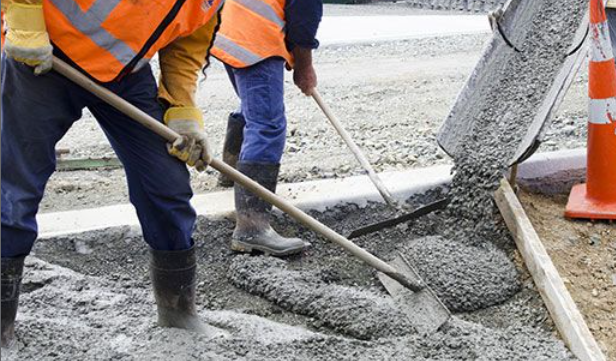
Grades that move water off working pavement fast and into San Diego’s storm system correctly — with the oil-and-fluid reality of an auto-service corridor respected: drainage designed so the first flush of a winter storm leaves the property through the intended path, not across a neighbor’s yard or a service bay threshold.
Permits, Big-City Edition: Navigating San Diego's DSD
Because Miramar is a City of San Diego community, right-of-way work here — approaches, curb connections, anything in the public street — runs through the Development Services Department’s Public Right-of-Way Permit system under Municipal Code Chapter 12: plans prepared to city forms and the San Diego Regional Standard Drawings, three permit tracks depending on scope (including a Rapid Review lane for smaller standard improvements under Information Bulletin 165), and a separate Traffic Control Permit where work affects the street — which brings its own choreography: notifications to Police, Fire, refuse collection, Transit, and Underground Service Alert five working days before work, and Tow-Away signage posted 72 hours ahead. San Diego’s citywide stormwater requirements ride along with this system too — construction-phase controls that keep sediment, grindings, and wash water out of a storm network bound for the region’s creeks and bays, handled as standard site practice on our projects. It’s a genuine machine, built for a city of 1.4 million — and it rewards contractors who run it routinely. We do: the permit track selection, the plan preparation, the notification chain, the stormwater controls, and the inspections are one line on your proposal.
Why miramar Property Owners Choose United Paving Co.
Licensed California Contractor
verify our license anytime through the CSLB license check.
Over 25 years in the asphalt and concrete industry
Serving properties from Los Angeles through San Diego County
Active members of the property-management community.
BOMA, IREM, CAI, ICSC, AGC, and more.
Materials and Methods
Free on-site written estimates
Throughout Miramar — 92126 (the Miramar Road industrial corridor and adjacent Mira Mesa), 92121 (the western industrial blocks toward Sorrento Valley and Sorrento Mesa), and 92145 (MCAS Miramar and its surrounding federal lands).
How a Quality Asphalt Paving Project Works, Step by Step
Most pavement failures trace back to shortcuts in the first three steps below — the ones buried underground when the job is “done.” Here’s the full process, so you know what to expect and what to ask any contractor bidding your project:
1. Site Evaluation & Soil Assessment
San Marcos sits on a mix of decomposed granite, sandy loam, and clay-heavy soils depending on where you are — and each behaves differently under load. Clay expands when saturated and shrinks when dry, flexing whatever sits on top of it. A contractor who quotes your project without evaluating the subgrade is guessing with your money.
2. Demolition & Excavation (for replacement projects)
Failed asphalt and contaminated base are removed and hauled off — and old asphalt is one of America's most recycled materials, routinely reprocessed into new pavement, as documented by the Asphalt Institute. We excavate to the depth the new pavement section requires, not just deep enough to hide the old problems.
3. Subgrade Preparation & Aggregate Base
The subgrade is compacted and proof-rolled to expose soft spots, which are dug out and rebuilt. Then Class II aggregate base is placed and compacted in lifts. This layer carries the structural load; the asphalt on top mostly protects it and provides the driving surface.
4. Fine Grading for Drainage
Surfaces are graded to a minimum slope (typically 1–2%) toward drains, gutters, and flowlines. Standing water after a storm is the most common visible symptom of grading that was skipped or done wrong.
5. Hot-Mix Asphalt Placement
Hot-mix asphalt arrives at roughly 300°F and must be placed and compacted before it cools. Thickness depends on use: a residential driveway section differs substantially from a truck-trafficked commercial lot. This is why a bid quoting "asphalt paving" without specifying compacted thickness isn't comparable to one that does.
6. Compaction & Finishing
Rollers compact the mat to target density while it's still workable. Proper compaction is the single biggest factor in pavement durability — under-compacted asphalt lets in air and water and ages years faster.
Miramar Asphalt Paving - FAQS
Miramar isn't an incorporated city — who actually issues our permits?
The City of San Diego, through its Development Services Department: Miramar is a San Diego community, so DSD's Right-of-Way Permit system, Regional Standard Drawings, and Traffic Control Permits govern any work touching public streets here. Private on-site paving generally needs no ROW permit — the line matters, and we establish it during scoping.
What does "designed for cycle counts" mean on an actual proposal?
It means the section is justified by traffic, in writing: estimated daily axle passes by zone, and the thickness/base/mix that duty requires — gates and aisles specified heavier than stalls. If a bid prices your fleet yard by the square foot without asking what drives on it, it hasn't priced your fleet yard.
Can an auto-service property repave without closing its bays?
Yes — bay-by-bay phasing is the corridor standard: approach lanes rebuilt in halves, temporary routing marked daily, and cure windows scheduled against your appointment book. The businesses that dread repaving are usually remembering an unphased project.
How does MCAS Miramar affect paving work nearby?
Mostly as a neighbor to plan around rather than a regulator: no special permits flow from base adjacency for ordinary private paving, but corridor traffic patterns (including gate-hour surges) inform smart phasing, and properties doing defense-adjacent work sometimes carry their own site-security requirements — which our crews accommodate routinely.
Does San Diego's Rapid Review lane actually speed things up?
For qualifying smaller standard improvements, meaningfully — it's the city's own acknowledgment that a driveway approach shouldn't wait in the same line as a subdivision. Eligibility is scope-based and staff-determined; we scope projects with the track in mind and tell you which lane yours rides.
What's the realistic timeline from proposal to finished pavement here?
Private on-site work: weeks, driven mostly by scheduling and phasing design. Work touching the ROW: add the DSD cycle — permit track, plan review, the five-day notification chain, 72-hour posting — which we run in parallel with mobilization planning so the machine's timeline and yours overlap instead of stack.
Areas We Serve NEAR Miramar
We work throughout the Miramar community of San Diego — the Miramar Road corridor from I-805 to I-15, the Camino Santa Fe and Black Mountain Road industrial streets, the Production Avenue and Dowdy Drive warehouse blocks, and the neighboring Mira Mesa, Kearny Mesa, and Sorrento Valley business areas. See our asphalt paving pages for Otay Mesa, Carlsbad, and Vista.