
Asphalt Paving in Escondido, CA
Escondido Asphalt Paving — New Life for North County's Oldest Lots
Escondido is one of North County’s original cities — incorporated in 1888 — and its pavement shows its history. Along Grand Avenue, East Valley Parkway, and the Auto Park Way industrial corridor, a large share of parking lots and private streets were built decades ago and are reaching, or well past, the end of their structural life. United Paving Co delivers asphalt paving in Escondido, CA at every scale — new construction, full removal and replacement, and fine grading — for the commercial centers, industrial sites, HOAs, and homeowners of the Hidden Valley.
This page explains how a quality paving project actually works, what Escondido’s inland climate does to asphalt, when the city’s encroachment permits apply, and how to judge whether aging pavement is a candidate for repair or reconstruction.
Your Pavement Maintenance Timeline
| When | What | Why |
|---|---|---|
| Year 1 | First seal coat (after full cure) | Locks in binder before UV oxidation starts |
| Every 3–5 years | Re-apply seal coat | Ongoing UV and moisture protection in our high-sun climate |
| Annually (fall) | Crack sealing | Closes entry points before winter rains reach the base |
| As needed | Patching, striping refresh | Addresses isolated damage; maintains ADA compliance |
| Year 15–25+ | Overlay or reconstruction | Even well-maintained pavement eventually reaches structural end-of-life |
Our Asphalt Paving Services In Escondido
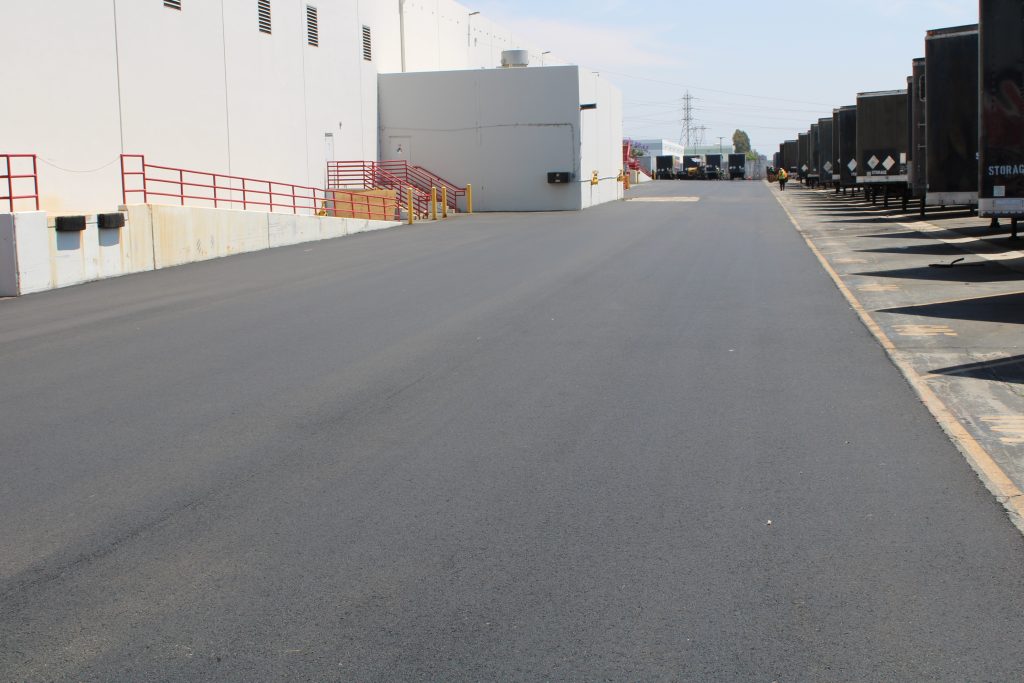
New Asphalt Construction
Ground-up paving for developments, commercial lots, private streets, and driveways — subgrade preparation, aggregate base, and hot-mix asphalt placed to National Asphalt Pavement Association standards, with compacted thickness specified in writing on every proposal. Fiber-reinforced (Forti-Fi) asphalt is available for heavy-traffic and high-stress areas.
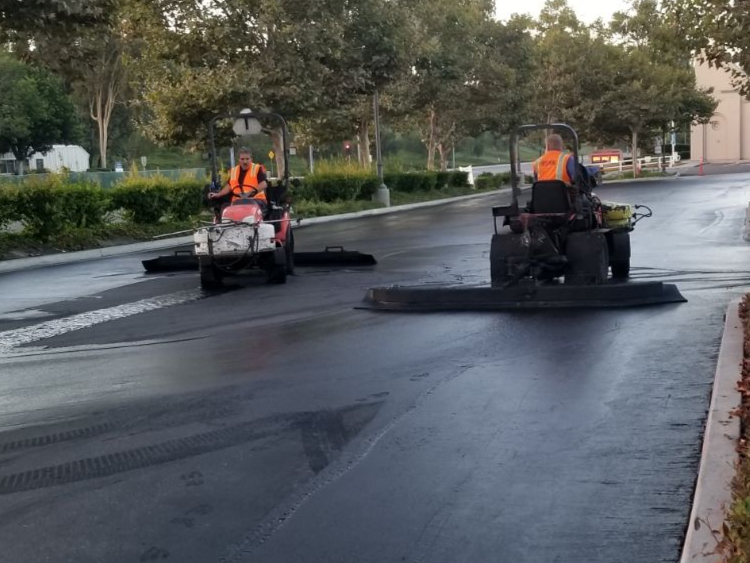
Asphalt Removal & Replacement
This is Escondido’s defining pavement need. Lots built in the 60s through the 90s are showing widespread alligator cracking and base failure that no surface treatment can reverse. We excavate the failed section and compromised base, rebuild the foundation, and install new hot-mix — a reset of the pavement’s structural clock, not a cosmetic patch over a failed one.
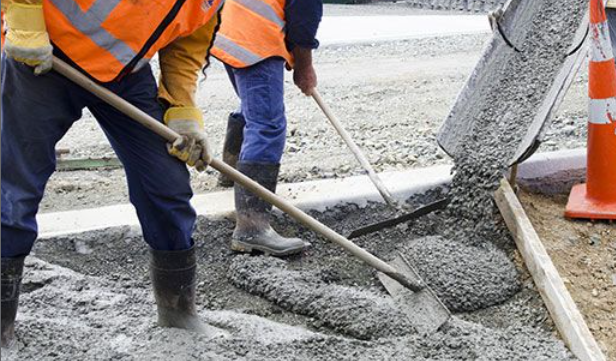
Fine Grading
Escondido’s valley-floor properties often have decades of settlement working against their original drainage design. Fine grading re-establishes the slopes that move winter storm water to drains and gutters instead of letting it pond — the single most common cause of premature failure we see on older Escondido lots.
Get Your Free Asphalt Paving Proposal
Our estimating and project management team will develop the right scope of work for your budget, performance goals, and visual expectations. Estimates and recommendations are free. Call (951) 739-9200 or submit the form below.
Inland Heat: Why Escondido Is Harder on Asphalt Than the Coast
Fifteen miles of separation from the ocean changes the physics. While coastal cities sit under the marine layer, Escondido’s summer afternoons routinely run into the 90s and beyond — and that heat works on asphalt three ways:
Accelerated oxidation
Heat speeds the UV-driven chemical aging of asphalt binder. The same pavement that grays and embrittles in 8 years near the coast can get there noticeably faster in the inland valley — which shortens the ideal seal coating cycle see Seal Coating in Escondido
Softening and deformation
On 95-degree afternoons, asphalt surfaces get hot enough to soften. Under truck traffic and power-steering turns, soft pavement ruts and shoves — which is why mix selection and compaction targets for Escondido projects should assume hot-service conditions.
Bigger daily swings
Inland valleys also cool sharply at night. That expansion-contraction cycle, repeated thousands of times, fatigues aging pavement faster than the coast’s mild, stable range. Add the December–March storm season pushing water through every crack that heat opened, and you have Escondido’s full deterioration cycle. We design mixes, sections, and maintenance plans for it.
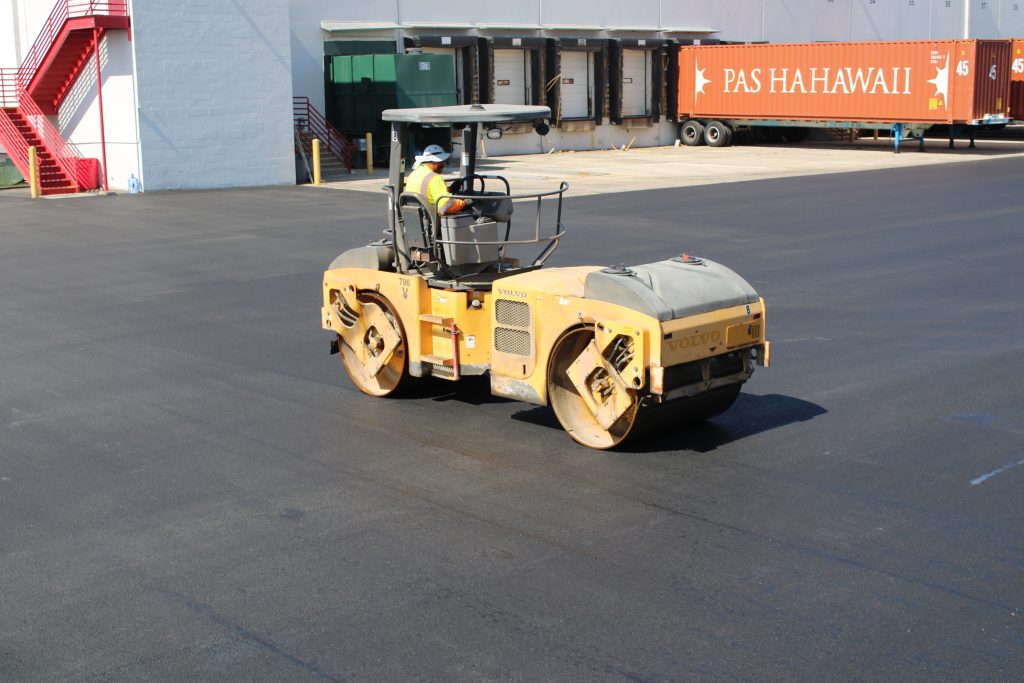
What Does Asphalt Paving Cost in Escondido?
The cost drivers mirror the city’s building stock: on older properties, the biggest variable is what’s under the surface. A lot with a sound base needing an overlay and one with a failed base needing full reconstruction can differ dramatically in cost per square foot — and you often can’t tell which you have until the pavement is evaluated properly. Size, pavement thickness for truck versus car traffic, drainage corrections, and phasing for occupied centers move the number from there. Our proposals itemize the scope so you’re comparing substance, not just totals.
Encroachment Permits & City Requirements in Escondido
Escondido requires an encroachment permit for any work in the public right-of-way — driveway approaches, curb cuts, sidewalk connections — processed through the city’s Field Engineering Division, which also inspects the work and enforces traffic-control requirements. Grading beyond exempt thresholds requires a separate grading permit from the City Engineer, and Escondido’s engineering department handles driveways, curb cuts, and stormwater requirements together. We pull the permits, prepare required traffic control, and coordinate the city’s inspections as part of every qualifying project.
Old Lot, New Pavement: How Reconstruction Works
For Escondido’s aging properties, replacement follows a disciplined sequence: evaluate the subgrade (valley-floor clay pockets and hillside decomposed granite behave completely differently under load), demolish and haul off the failed asphalt — most of it headed for recycling into new pavement, a practice documented by the Asphalt Institute — then rebuild the base in compacted lifts, re-establish drainage grades, and place hot-mix at the thickness the traffic actually requires. A 40-year-old lot usually predates current drainage and accessibility standards, so reconstruction is also the natural moment to correct ponding and bring ADA stalls and routes up to code see Striping & ADA Compliance in Escondido
Why Escondido Property Owners Choose United Paving Co.
Licensed California Contractor
verify our license anytime through the CSLB license check.
Over 25 years in the asphalt and concrete industry
Serving properties from Los Angeles through San Diego County
Active members of the property-management community.
BOMA, IREM, CAI, ICSC, AGC, and more.
Materials and Methods
Free on-site written estimates
Throughout Escondido —92025 (Central Escondido) 92026 (Northeastern Escondido and Hidden Meadows. 92027 (Eastern and southeastern Escondido). 92029 (Western/southwestern Escondido)
How a Quality Asphalt Paving Project Works, Step by Step
Most pavement failures trace back to shortcuts in the first three steps below — the ones buried underground when the job is “done.” Here’s the full process, so you know what to expect and what to ask any contractor bidding your project:
1. Site Evaluation & Soil Assessment
San Marcos sits on a mix of decomposed granite, sandy loam, and clay-heavy soils depending on where you are — and each behaves differently under load. Clay expands when saturated and shrinks when dry, flexing whatever sits on top of it. A contractor who quotes your project without evaluating the subgrade is guessing with your money.
2. Demolition & Excavation (for replacement projects)
Failed asphalt and contaminated base are removed and hauled off — and old asphalt is one of America's most recycled materials, routinely reprocessed into new pavement, as documented by the Asphalt Institute. We excavate to the depth the new pavement section requires, not just deep enough to hide the old problems.
3. Subgrade Preparation & Aggregate Base
The subgrade is compacted and proof-rolled to expose soft spots, which are dug out and rebuilt. Then Class II aggregate base is placed and compacted in lifts. This layer carries the structural load; the asphalt on top mostly protects it and provides the driving surface.
4. Fine Grading for Drainage
Surfaces are graded to a minimum slope (typically 1–2%) toward drains, gutters, and flowlines. Standing water after a storm is the most common visible symptom of grading that was skipped or done wrong.
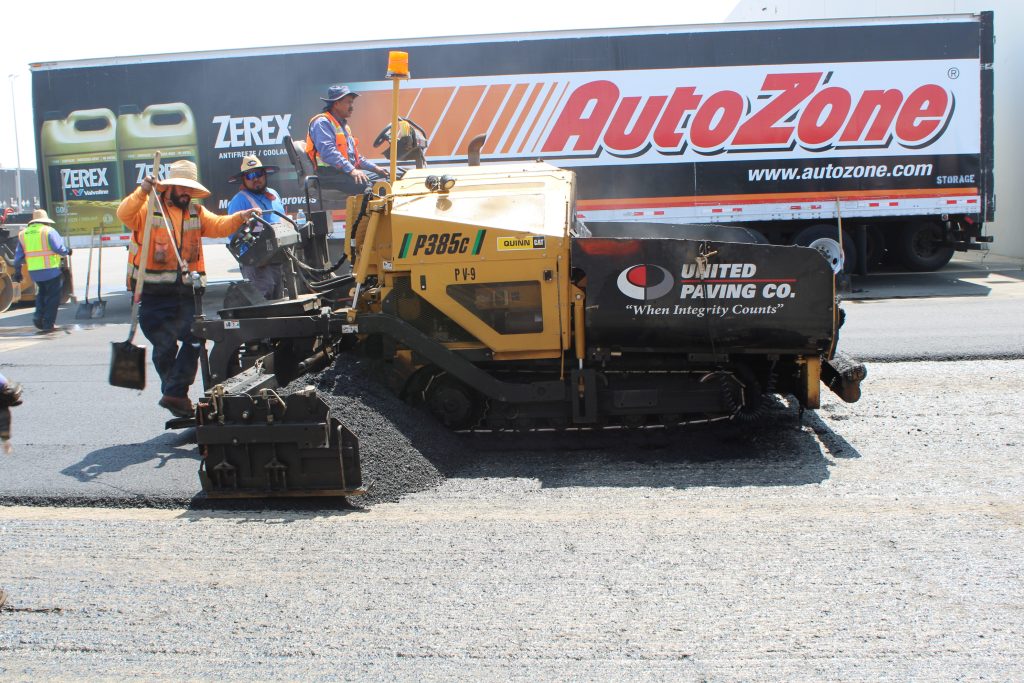
5. Hot-Mix Asphalt Placement
Hot-mix asphalt arrives at roughly 300°F and must be placed and compacted before it cools. Thickness depends on use: a residential driveway section differs substantially from a truck-trafficked commercial lot. This is why a bid quoting "asphalt paving" without specifying compacted thickness isn't comparable to one that does.
6. Compaction & Finishing
Rollers compact the mat to target density while it's still workable. Proper compaction is the single biggest factor in pavement durability — under-compacted asphalt lets in air and water and ages years faster.
Escondido Asphalt Paving - FAQS
My lot was built in the 1970s. Can it be overlaid, or does it need full replacement?
It depends on the base, not the age. If the original base is still sound and distress is limited, a mill-and-overlay can add 15+ years economically. If alligator cracking is widespread and the lot flexes underfoot, the base has failed and an overlay will telegraph cracks through within a couple of years. We evaluate before recommending — sometimes the answer is the cheaper one.
Does Escondido's heat change what kind of asphalt I should use?
It changes the specification conversation. Hot inland service argues for mix designs and compaction standards that resist softening and rutting, and heavy-traffic areas are strong candidates for fiber-reinforced asphalt. This is exactly why a bid should state its mix and thickness.
Do I need a permit to repave my parking lot in Escondido?
Work entirely on private property generally doesn't require an encroachment permit — but the moment the project touches the right-of-way (approaches, curb cuts, sidewalk), Field Engineering's encroachment permit and inspections apply. Grading thresholds can also trigger a grading permit. We sort out which apply and handle them.
When is paving season in Escondido?
Long. Hot-mix wants warm, dry conditions, and the inland valley supplies them most of the year — summer heat is actually favorable for compaction. We schedule around December–March storms, but there's no extended off-season.
How long will a new lot last in Escondido?
With proper base construction and a maintenance program adapted to inland conditions — crack sealing annually, seal coating on the earlier side of the 3–5 year cycle — 20+ years is a realistic expectation. Unmaintained pavement in this heat ages on the fast end of every curve.
Can you phase a replacement so our center stays open?
Yes — phased demolition and paving with maintained access is standard for our occupied retail, industrial, and HOA work, including night and weekend scheduling on high-traffic Escondido corridors.
Areas We Serve NEAR San Marcos
We pave throughout Escondido — from downtown’s Grand Avenue district to the Auto Park Way and Centre City Parkway commercial corridors, the I-15 business parks, and residential communities from Old Escondido to Felicita and Hidden Meadows. See our asphalt paving pages for San Marcos, Vista, and Carlsbad.