
Asphalt Repair and Maintenance in Otay MEsa, ca
Asphalt Repair and Maintenance — Fixing What Standing Freight Carves Into a Yard
Every pavement district has a signature failure, and Otay Mesa’s is written in ruts: the twin channels worn down queue lanes, the trailer-axle depressions stamped across parking rows, the shoved washboard at every gate where a million annual border crossings translate into loaded trucks braking to a stop. This is deformation country — damage carved by weight standing still — and it calls for different repairs than the cracking that dominates everywhere else. United Paving Co provides asphalt repair in Otay Mesa, CA for the mesa’s logistics properties: rut and depression repair engineered to duty, yard maintenance run at acreage scale, and scheduling that works between the border’s traffic surges.
Our Asphalt Repair and Maintenance in Otay Mesa
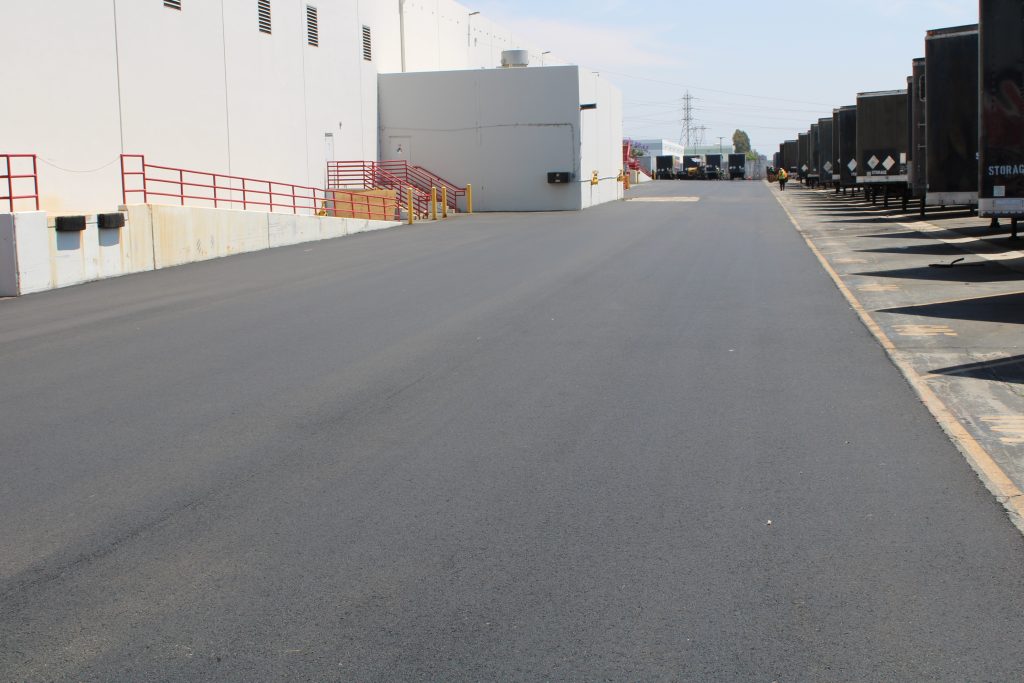
Rut & Deformation Repair
The mesa’s core repair: ruts and depressions corrected by removing the deformed material to sound depth and rebuilding with deformation-resistant sections — because a rut filled with more of the mix that flowed the first time is a rut on a return schedule. Where the standing loads that caused the damage are permanent, the repair proposal says so and prices the concrete graduation alongside the asphalt fix.
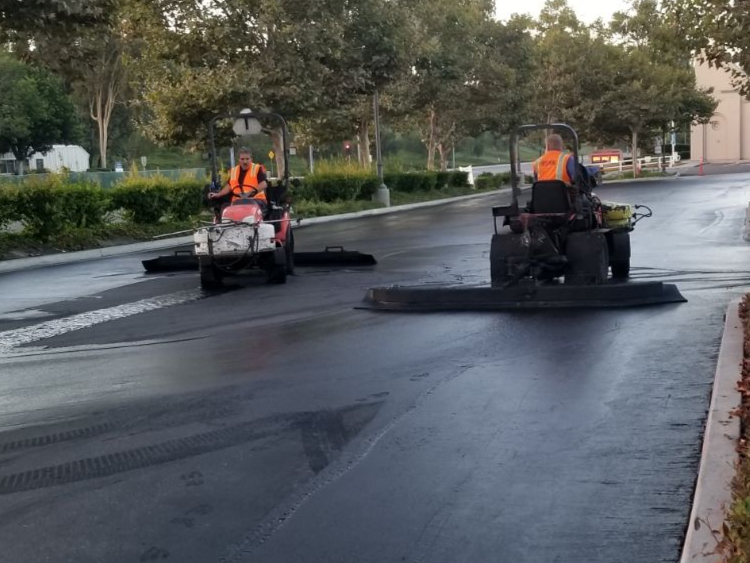
Threshold, Gate & Approach Reconstruction
Rebuilds of the small zones that tax every movement — shoved gate thresholds, washboarded scale approaches, broken dock-court entries — hardened to heavier sections than original, with overnight and weekend execution that keeps a working yard’s arteries open.
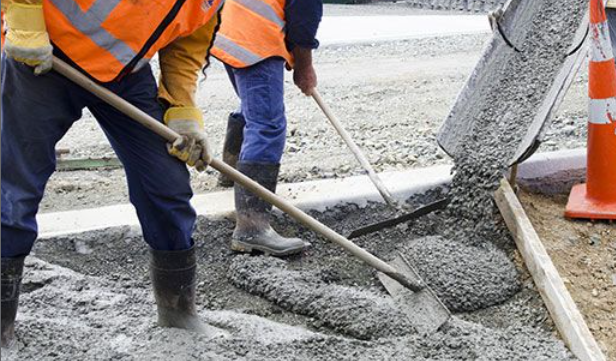
Yard-Scale Maintenance Programs
Standing programs sized to logistics parcels: acreage-scale crack sealing on the fall calendar, condition mapping that tracks deformation depth year over year (rut progression is measurable, and measuring it is how repairs get scheduled before they become reconstructions), and budget documents built for the landlords and 3PLs that run the mesa’s real estate.
Get Your Free Asphalt Repair and Maintenance Proposal
Send us photos or schedule a site walk — our estimators will priority-rank what actually needs repair now, what can wait, and what maintenance will keep you off the expensive end of the curve. Call (951) 739-9200 or submit the form below!
Reading Deformation: What the Shape of the Damage Tells You
Cracking tells you about water and age; deformation tells you about loads and time, and the mesa’s shapes are a legible language. Uniform ruts down a lane — smooth channels tracking the wheel paths — mean the asphalt itself is flowing under creep loading: the mix is too soft for the duty, and the fix is removal and replacement with a stiffer section in the trafficked width. Ruts with humps beside them — material pushed up along the channel edges — confirm plastic flow vividly: the pavement isn’t compacting down, it’s moving sideways, and heat is usually a co-conspirator. Sharp-edged depressions at regular spacings — the mesa’s parking-row signature — mark standing axle and landing-gear positions: point-load damage at the spots where trailers live, arguing for concrete strips at exactly those lines rather than acres of upgrade. Washboard at stopping points is braking force shoving soft surface material into waves — a mix and bond problem at the threshold, fixed by rebuilding the braking zone in a shove-resistant section. And one impostor matters: depressions with cracking webbed through them aren’t pure deformation — that’s base failure underneath, water’s work rather than weight’s alone, and it needs excavation and base reconstruction, not just surface correction. The diagnosis drives the money: surface flow needs a better mix; base failure needs a deeper dig; standing-point damage needs material graduation — and reading the shape correctly is the difference between buying the fix once and renting it annually.
Maintenance at Acreage Scale: Running a Yard Like the Asset It Is
A twenty-acre yard can’t be maintained like a strip-mall lot times forty — scale changes the playbook. Sweeping becomes structural, not cosmetic: the mesa’s dry dust and the aggregate dragged from any unpaved edges act as grinding paste under thousands of tires, accelerating surface wear measurably; scheduled sweeping is the cheapest wear reduction available at this scale. The paved/unpaved interface is a managed frontier: where yards meet gravel storage or undeveloped mesa, rock migration onto pavement chips surfaces and dents thresholds — hardened transition aprons and interface housekeeping keep the frontier from advancing. Crack sealing runs as an annual campaign, priced by the mile rather than the crack, sequenced across the yard’s sections each fall before the storm season — because on parcels this size, the December–March rains that saturate one neglected acre’s base are rehearsing what they’ll do to the other nineteen. And measurement replaces impressions: annual rut-depth readings at fixed stations turn “the queues seem worse” into a trend line, which turns repair timing into a scheduled decision instead of an emergency one. The preservation economics underneath are the standard federal math — treat sound pavement early and cheaply or rebuild failed pavement late and expensively — applied to properties where the difference between the two paths is measured in acres.
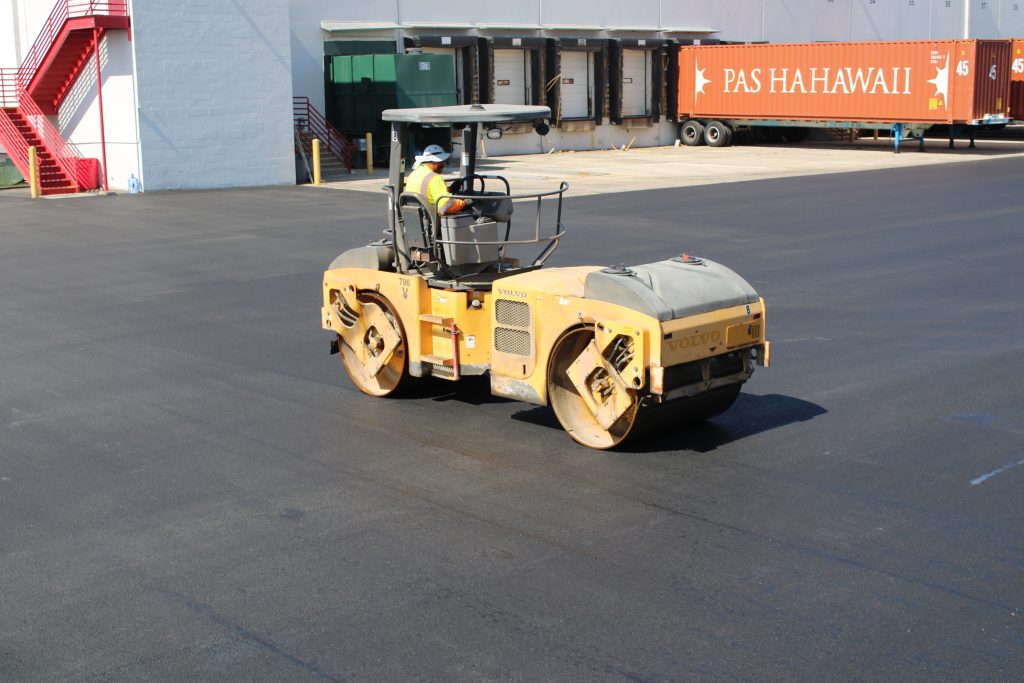
Your Pavement Maintenance Timeline
| When | What | Why |
|---|---|---|
| Year 1 | First seal coat (after full cure) | Locks in binder before UV oxidation starts |
| Every 3–5 years | Re-apply seal coat | Ongoing UV and moisture protection in our high-sun climate |
| Annually (fall) | Crack sealing | Closes entry points before winter rains reach the base |
| As needed | Patching, striping refresh | Addresses isolated damage; maintains ADA compliance |
| Year 15–25+ | Overlay or reconstruction | Even well-maintained pavement eventually reaches structural end-of-life |
Repair Scheduling in a 24-Hour Trade District
The mesa never fully sleeps — the port’s commercial rhythm runs long hours, and the yards echo it — but it does breathe: overnight and early-morning lulls between the afternoon crossing surges are the repair windows this district runs on. Our mesa projects are scheduled against that respiration: queue-lane rebuilds executed in the small hours and trafficable by the morning build-up, gate and threshold work sequenced so a yard never loses its last open artery, and phasing maps coordinated with dispatch so drivers meet cones exactly where the notices said they would. Where a repair touches the public street, San Diego’s Traffic Control Permit machinery arrives with it — the five-working-day agency notifications and 72-hour signage under the city’s Information Bulletin 177 — run as contractor scope with the clock built into the schedule from the estimate onward.
Why Otay Mesa Property Owners Choose United Paving Co
Licensed California Contractor
verify our license anytime through the CSLB license check.
Over 25 years in the asphalt and concrete industry
Serving properties from Los Angeles through San Diego County
Active members of the property-management community.
BOMA, IREM, CAI, ICSC, AGC, and more.
Materials and Methods
Free on-site written estimates
Throughout Miramar — 92126 (the Miramar Road industrial corridor and adjacent Mira Mesa), 92121 (the western industrial blocks toward Sorrento Valley and Sorrento Mesa), and 92145 (MCAS Miramar and its surrounding federal lands).
Otay Mesa Asphalt Repair and Maintenance - FAQs
We filled our queue-lane ruts last year and they're back. What went wrong?
The refill matched the original mix — the one that flowed under creep loading the first time — so the same duty produced the same flow. Durable rut repair removes the deformed material and rebuilds the trafficked width in a stiffer, deformation-resistant section; anything less is scheduled maintenance disguised as a fix.
Our parking rows have dents at every trailer position. Do we repair the asphalt or change the material?
At the landing-gear and axle lines, change the material: concrete strips at the standing positions end that specific damage permanently, while the asphalt between rows — which only gets rolled over, not stood on — stays economical. It's a surgical graduation, not a yard-wide one.
Is dust really a pavement problem or just a housekeeping annoyance?
Both, which is the point: mesa dust and tracked aggregate work as abrasive under tire loads, measurably accelerating surface wear at yard scale. A sweeping contract is genuinely a pavement-preservation line item here — unglamorous, cheap, and effective.
How do you measure whether our ruts are getting worse fast enough to matter?
With a straightedge and fixed stations: rut depth read at the same points annually turns deterioration into a trend line. Shallow and stable can wait on the program; deepening year over year gets scheduled before the ruts start holding winter water — because a water-filled rut is a base failure in rehearsal.
Can you work around our customs and appointment schedules?
That's the mesa's baseline requirement: repairs slotted into the overnight respiration between crossing surges, phasing coordinated with dispatch, and hard commitments on reopening times — because on this district's yards, a missed morning reopening isn't an inconvenience, it's a queue on the public street.
Our yard borders unpaved land and the pavement edge keeps breaking. What's the fix?
A hardened transition: thickened edge sections or a concrete apron at the interface, plus grading that keeps the unpaved side's material and stormwater from migrating onto the pavement. Edge failures at open frontiers are geometry problems first — rebuilding the edge without managing the interface just restarts the erosion.
Areas We Serve NEAR Otay Mesa
We work throughout the Otay Mesa community of San Diego — 92154, from the Otay Mesa Road and Airway Road industrial corridors to the La Media, Britannia, and Siempre Viva logistics blocks near the port of entry — plus the SR-905/SR-125 corridor parcels and neighboring San Ysidro and Ocean View Hills. See our asphalt repair pages for Miramar, Carlsbad, and Vista.