
Asphalt Repair and Maintenance in Miramar, ca
Asphalt Repair and Maintenance — Fixing Pavement That Can't Afford to Stop
On most properties, a pothole is an eyesore. On Miramar Road, it’s a business problem with a meter running: a failed approach lane meters cars away from an auto-service bay, a broken gate apron slows every fleet cycle behind it, and a rough dock lane taxes every trailer that crosses it, shift after shift. United Paving Co provides asphalt repair in Miramar, CA built around that arithmetic — repairs diagnosed for a corridor that never rests its pavement, executed in the hours your operation can spare, and permitted through San Diego’s system when the damage sits where the city’s rules apply.
Our Asphalt Repair and Maintenance in Miramar
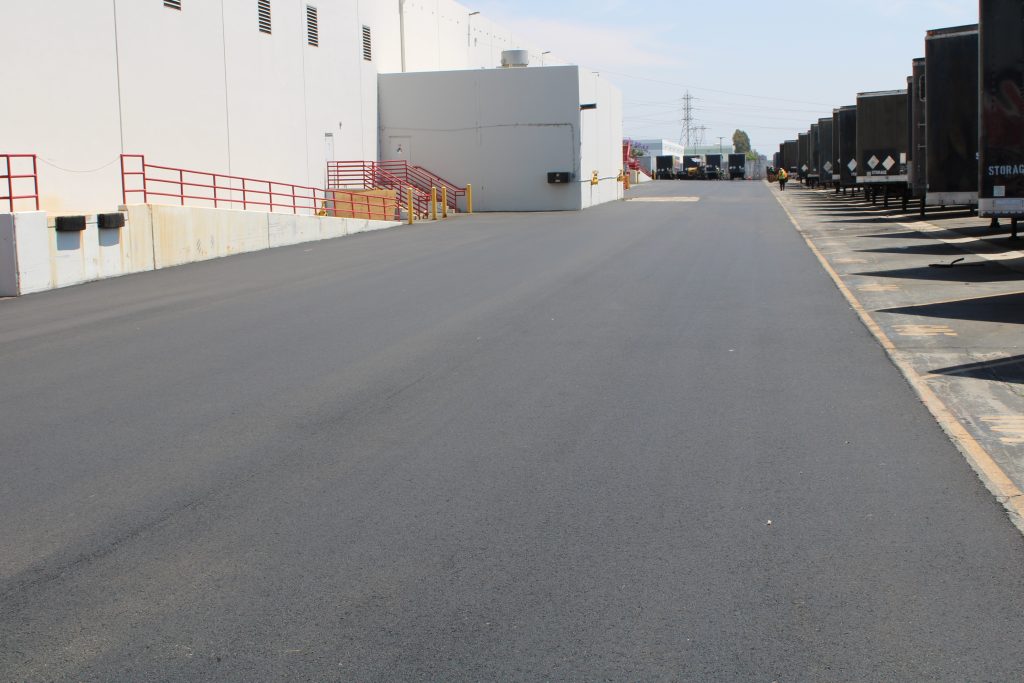
Uptime-First Patching & Reconstruction
Remove-and-replace repair of failed zones — excavated to sound material, base rebuilt, hot-mix compacted back to duty spec — scheduled and phased so the repair costs hours of access, not days: night and early-morning windows as the corridor default, half-width lane repairs that keep traffic moving, and 24-hour return-to-service as the planning standard.
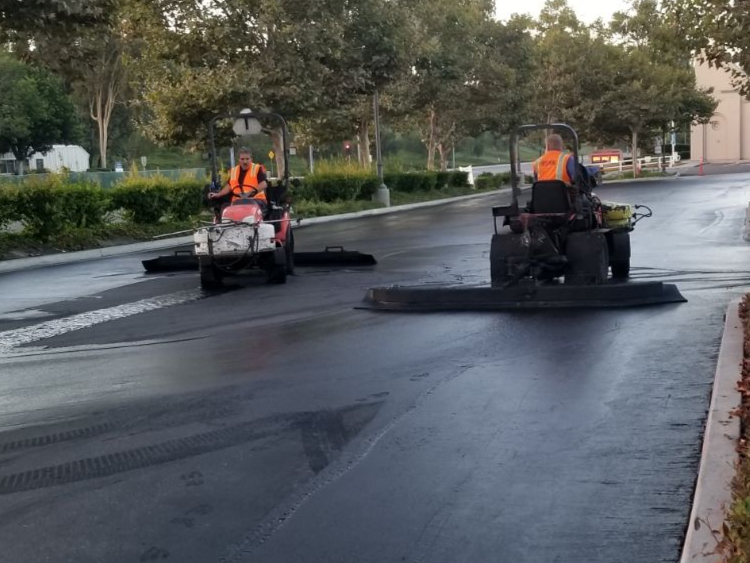
High-Cycle Zone Hardening
The repair that ends repeat repairs: rebuilding the specific spots Miramar’s traffic frequency destroys — gate throats, approach lanes, drive-aisle intersections, dumpster paths — to heavier sections than the original, because a failure point that’s already failed under this corridor’s cycle counts has announced what the original spec was missing.
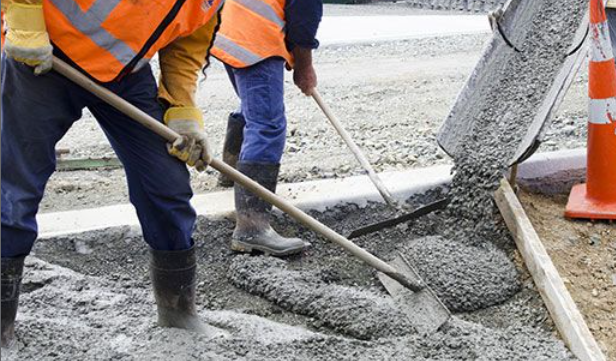
Crack Sealing & Corridor Maintenance Programs
Hot-applied crack sealing on the fall calendar ahead of San Diego’s storm season, plus standing programs for the corridor’s property types — fleet operators, warehouse landlords, auto-service owners — with condition mapping, night-work scheduling baked in, and budgets built for businesses that plan in uptime.
Get Your Free Asphalt Repair and Maintenance Proposal
Send us photos or schedule a site walk — our estimators will priority-rank what actually needs repair now, what can wait, and what maintenance will keep you off the expensive end of the curve. Call (951) 739-9200 or submit the form below!
Fatigue Without Rest: Reading High-Frequency Failure
Miramar’s damage patterns tell a frequency story, and reading them correctly is what separates a fix from a subscription. Fatigue alligatoring in the travel lanes — fine, interconnected cracking along the paths every vehicle shares — is the signature: not one heavy load but millions of moderate ones, arriving faster than the asphalt’s recovery clock. It progresses on a knowable timeline — hairline mesh first, then interconnection, then loose pieces working free under traffic, then potholes — and each stage is markedly cheaper to catch than the next: sealed at the mesh stage, patched at interconnection, reconstructed after that. Patching restores the surface at any stage; only a heavier rebuilt section changes the arithmetic that caused it.
Polished, worn wheel paths mark the same lanes earlier still — the surface aging in fast-forward where cycles concentrate, a free early warning most owners walk past, while stall areas a few feet away stay years younger. Failures that return to the same spot are the corridor’s honest feedback: the location’s duty exceeds its section, and the third repair should be a redesign, not a third identical patch — we keep repair-location histories on program properties precisely to catch these repeat offenders on paper before they announce themselves again in asphalt. And water damage compounds it all: the crack network frequency opens is the entry system San Diego’s December–March storms exploit, which is why fall crack sealing earns more here per gallon than almost anywhere — every crack closed in October is a winter’s worth of base erosion that never happens under pavement that can least afford the downtime.
Triage by Revenue: Ranking Repairs on a Working Property
Repair budgets on this corridor should be ranked by operational arithmetic, not by how bad the damage looks — and the arithmetic is simple: multiply each failure’s severity by how many revenue-bearing movements cross it daily. A modest failure in the gate throat outranks a worse one in a back corner, because the gate taxes every vehicle the business runs; service-queue and approach-lane damage ranks next, since it meters customers toward the bays that bill; spine-aisle failures tax circulation broadly; and stall-field damage — often the most visually alarming — frequently ranks last, because a cracked stall costs almost nothing per day to tolerate while a rough gate costs something on every cycle. The same logic sets urgency: anything that slows or hazards the money path gets night-scheduled now; cosmetic damage waits for the fall program. Our repair proposals arrive pre-ranked on exactly this framework — each item scored by location duty, with the defer-safely list stated as plainly as the fix-now list — because on a throughput property, the most expensive repair mistake isn’t overpaying for a patch; it’s spending the budget in the wrong order.
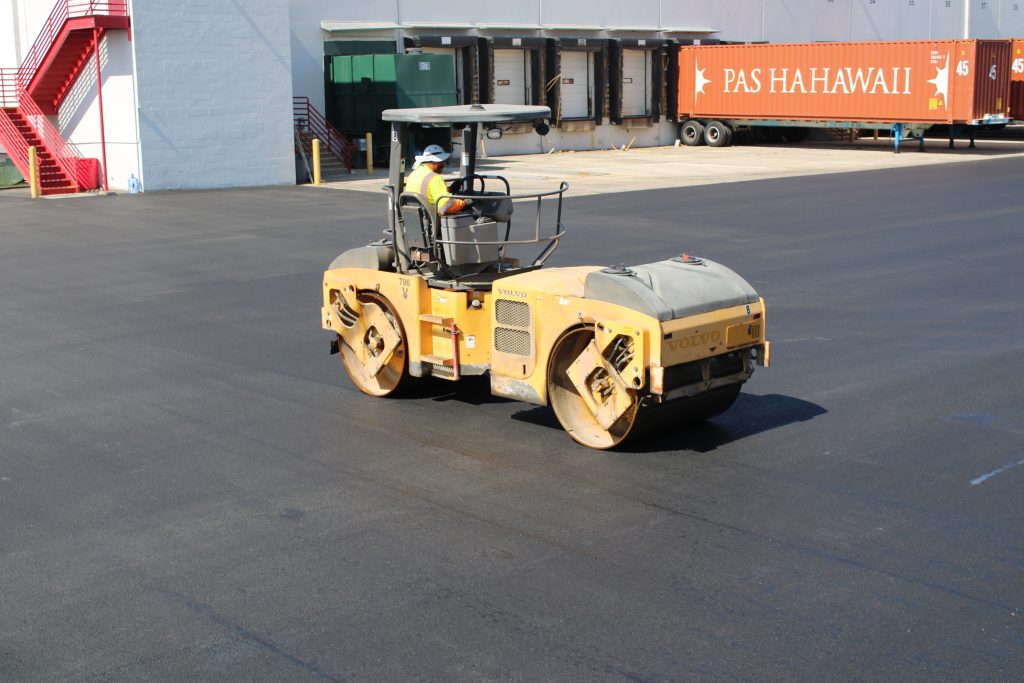
Your Pavement Maintenance Timeline
| When | What | Why |
|---|---|---|
| Year 1 | First seal coat (after full cure) | Locks in binder before UV oxidation starts |
| Every 3–5 years | Re-apply seal coat | Ongoing UV and moisture protection in our high-sun climate |
| Annually (fall) | Crack sealing | Closes entry points before winter rains reach the base |
| As needed | Patching, striping refresh | Addresses isolated damage; maintains ADA compliance |
| Year 15–25+ | Overlay or reconstruction | Even well-maintained pavement eventually reaches structural end-of-life |
When Repair Meets the Street: San Diego's Traffic Control Machine
Repairs confined to private property answer only to your schedule. The moment a repair touches the public right-of-way — an approach apron, curb-adjacent failure, anything in the street — San Diego’s rules arrive with it: a Public Right-of-Way Permit, and where the work affects traffic, a Traffic Control Permit under the city’s Information Bulletin 177, whose choreography is genuinely metropolitan — traffic control plans for review, notifications to Police, Fire, refuse collection, Transit, and Underground Service Alert five working days before work begins, Tow-Away/No-Parking signs posted 72 hours ahead, and driveway-closure notice to affected owners and tenants. On a corridor as traffic-dense as Miramar Road, this isn’t bureaucratic decoration — it’s how a repair happens without becoming the day’s traffic story. We run the full sequence as contractor scope, and we schedule the five-day clock into every ROW-adjacent repair from the first estimate, so the notification chain never becomes the surprise that delays your fix.
Why Miramar Property Owners Choose United Paving Co.
Licensed California Contractor
verify our license anytime through the CSLB license check.
Over 25 years in the asphalt and concrete industry
Serving properties from Los Angeles through San Diego County
Active members of the property-management community.
BOMA, IREM, CAI, ICSC, AGC, and more.
Materials and Methods
Free on-site written estimates
Throughout Miramar — 92126 (the Miramar Road industrial corridor and adjacent Mira Mesa), 92121 (the western industrial blocks toward Sorrento Valley and Sorrento Mesa), and 92145 (MCAS Miramar and its surrounding federal lands).
Miramar Asphalt Repair and Maintenance - FAQs
The same section of our lot has failed three times. What are we doing wrong?
Buying the same section three times. A repeat failure location is the pavement reporting that its duty exceeds its design — the durable fix rebuilds that zone heavier (deeper base, thicker or reinforced asphalt), which costs more than patch number three and less than patches four through eight.
Can repairs really happen overnight without disrupting our morning opening?
On this corridor it's the standard play: excavation, base work, paving, and compaction sequenced through the night, with hot-mix patches trafficable by opening. Larger repairs phase across nights. Your service writer shouldn't learn the repair happened from anything but the smooth pavement.
Our damaged approach is partly on our property and partly at the street. How does that work?
As one project with two rulebooks: the private portion runs on your schedule; the ROW portion carries San Diego's permit and — if traffic is affected — the Traffic Control Permit with its five-day notification clock and 72-hour signage. We split the scope on paper, run both tracks in parallel, and build it as one seamless repair.
Is night work noisier for our neighbors than daytime work would be?
It's quieter than the alternative costs: the corridor's businesses overwhelmingly prefer contained overnight noise to daytime access loss, and our night protocols — staged deliveries, directional lighting, compaction sequencing — are built from years of exactly this work. Where a site borders residential edges, we adjust the windows accordingly.
What should a fleet yard's annual maintenance actually include here?
Three lines: fall crack sealing before the storms, a condition walk that maps the high-cycle zones' progression year over year, and immediate patching of any failure in a gate or scale lane — because on a fleet property, those two spots tax every single vehicle movement, making them the highest-ROI repairs on the site.
Do you coordinate with tenants in multi-tenant industrial buildings?
Fully — notices, dock schedules, and phasing maps are part of scope, and on this corridor we've learned the golden rule of multi-tenant repair: the tenant who wasn't told is the tenant who parks on the fresh patch.
Areas We Serve NEAR Miramar
We work throughout the Miramar community of San Diego — the Miramar Road corridor from I-805 to I-15, the Camino Santa Fe and Black Mountain Road industrial streets, the Production Avenue and Dowdy Drive warehouse blocks, and the neighboring Mira Mesa, Kearny Mesa, and Sorrento Valley business areas. See our asphalt repair pages for Otay Mesa, Carlsbad, and Vista.