
Asphalt Paving in Otay MEsa, CA
Asphalt Paving — Pavement for the Border's Slowest, Heaviest Traffic
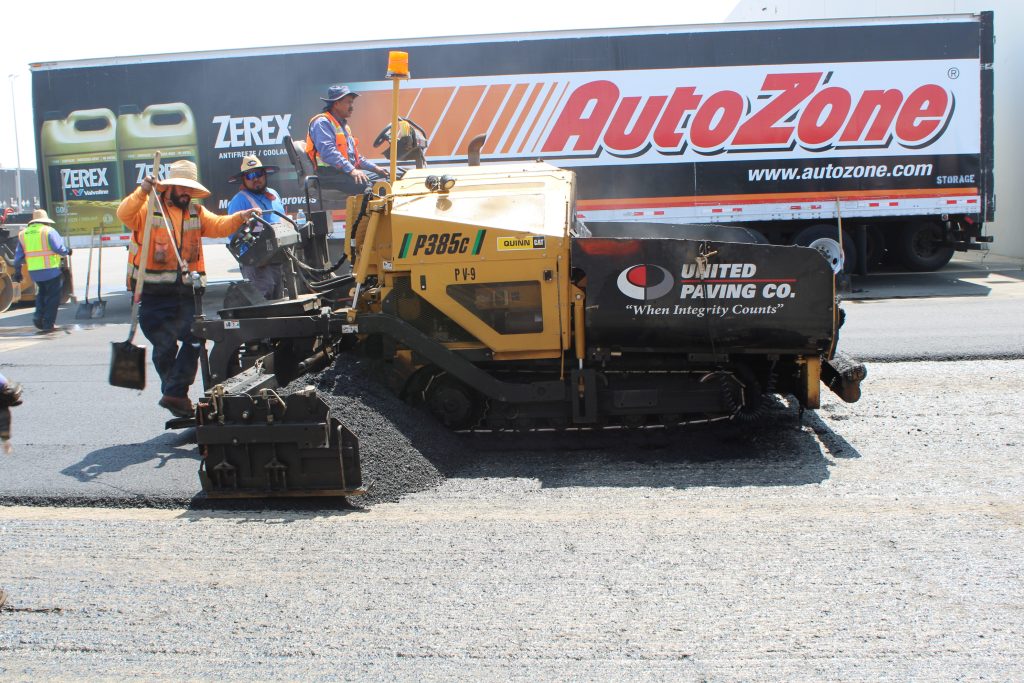
Otay Mesa is where California meets its supply chain: more than a million loaded trucks a year cross through the state’s busiest commercial port of entry and fan out across the mesa’s cross-docks, drayage yards, customs-broker lots, and truck parking fields. And here’s the twist that defines pavement on this mesa — the trucks aren’t speeding across it. They’re queuing, creeping, idling, and parking, and slow, heavy, long-duration loading is the most punishing thing that can happen to asphalt. United Paving Co provides asphalt paving in Otay Mesa, CA engineered for exactly that: new construction, removal and replacement, and fine grading built for freight that stands still.
The Parking-Brake Problem: Why Standing Freight Beats Pavement Harder Than Moving Freight
Here’s the physics that makes Otay Mesa its own pavement universe. Asphalt is viscoelastic — under load it behaves partly like a spring and partly like an extremely slow liquid, and which personality answers depends almost entirely on how long the load stays. A truck rolling past at speed loads any given spot for a fraction of a second: the spring side responds, the pavement deflects microscopically and recovers completely, and the surface is none the worse. Slow that same truck to a border queue’s creep and each wheel now presses each spot for seconds at a time, repeated down identical wheel paths all day; stop it at a gate and the load holds for minutes; park a loaded trailer overnight — or for the weekend a customs hold sometimes demands — and the liquid personality takes over entirely: the binder-and-aggregate structure literally flows away from the sustained pressure, microscopically per event but cumulatively and permanently, because unlike the spring response, plastic flow doesn’t flow back.
The mesa’s damage catalog is that physics made visible. Ruts carve down queue lanes where thousands of loaded trucks creep the same paths — smooth twin channels, often with material humped along their edges, the signature of asphalt moving sideways rather than compacting down. Twin depressions stamp across parking rows at exactly the axle and landing-gear spacings of the trailers that stand there night after night — point loads that concentrate a loaded trailer’s front tonnage through steel plates the size of dinner plates. Washboard shoving ripples every threshold where heavy vehicles brake to a stop, horizontal force pushing warm surface material into waves. And heat multiplies all of it at the worst possible time: the mesa runs hotter and drier than the coastal cities, summer surface temperatures soften the binder precisely during the afternoon crossing surges when the standing loads are heaviest and longest — the district’s damage season and its busy season are the same season.
The design answer follows the physics rather than fighting it. “Thicker” alone isn’t the fix — thickness resists deflection, but stiffness resists flow, so standing zones get deformation-resistant mix designs (harder binder grades, angular aggregate structures that interlock against movement) on top of deep structural sections. The zones are specified separately because the duty differs by orders of magnitude between a circulation lane and a queue lane fifty feet apart. And where loads stand longest — landing-gear lines, gate hold positions, scale approaches — the honest answer graduates past asphalt entirely to concrete, which doesn’t flow no matter how long the load stays (see [Concrete Installation & Repair in Otay Mesa]. A yard bid that doesn’t ask where trucks stop and how long they stand hasn’t engaged the mesa’s actual physics — it’s pricing a parking lot for a district that doesn’t build parking lots.
Get Your Free Asphalt Paving Proposal
Our estimating and project management team will develop the right scope of work for your budget, performance goals, and visual expectations. Estimates and recommendations are free. Call (951) 739-9200 or submit the form below.
Your Pavement Maintenance Timeline
| When | What | Why |
|---|---|---|
| Year 1 | First seal coat (after full cure) | Locks in binder before UV oxidation starts |
| Every 3–5 years | Re-apply seal coat | Ongoing UV and moisture protection in our high-sun climate |
| Annually (fall) | Crack sealing | Closes entry points before winter rains reach the base |
| As needed | Patching, striping refresh | Addresses isolated damage; maintains ADA compliance |
| Year 15–25+ | Overlay or reconstruction | Even well-maintained pavement eventually reaches structural end-of-life |
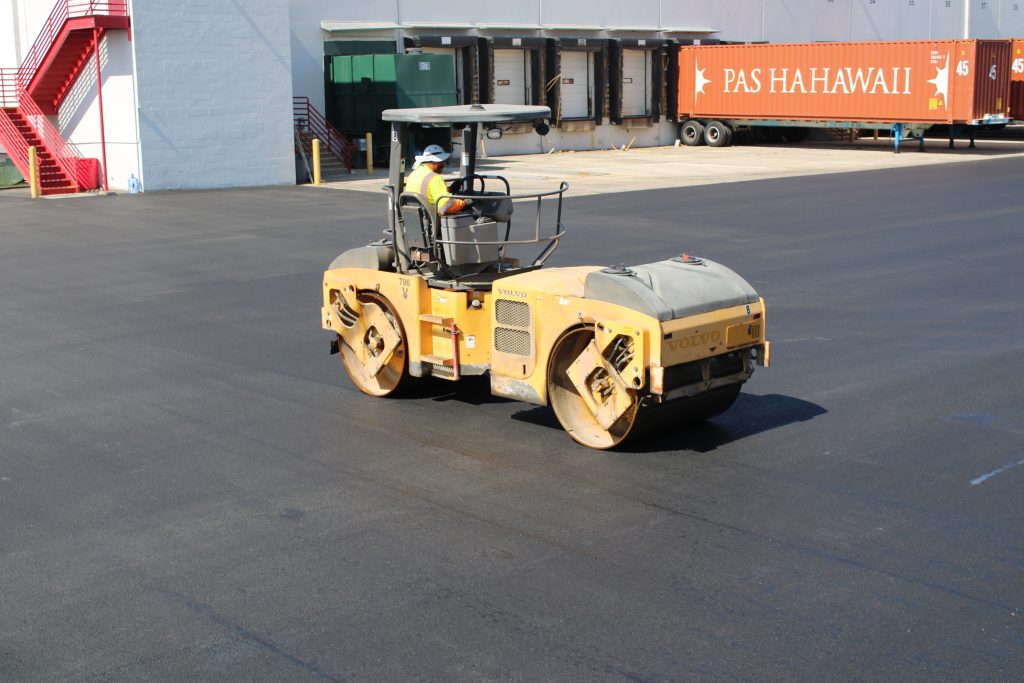
Designing the Yard: Pavement as Logistics Infrastructure
On a border-logistics property, the pavement layout is an operations document, and building it right means designing traffic before designing thickness. The queue geometry comes first — where trucks stack for gates and docks, at what depth on the worst afternoon (the port’s own rhythm, with its documented peak-period backups, sets the tempo the yards inherit) — because queue lanes are the highest-duration duty on the site and earn the heaviest flexible sections. Staging and parking fields come second, laid out so trailer rows land on pavement designed for standing axles, with dolly-pad concrete at landing-gear lines. Circulation ties it together at a lighter (but still loaded-truck) spec, and the scale-and-inspection movements every cargo truck makes in this district — the same weigh-and-check choreography Caltrans runs at the port’s Commercial Vehicle Enforcement Facility — are a reminder that mesa pavement serves trucks at full legal weight as the baseline case, not the exception. We design yards from the movement map outward: the proposal shows the zones, their duty, and their sections, so the owner can see the logistics logic under the asphalt.
Our Asphalt Paving Services In Otay Mesa
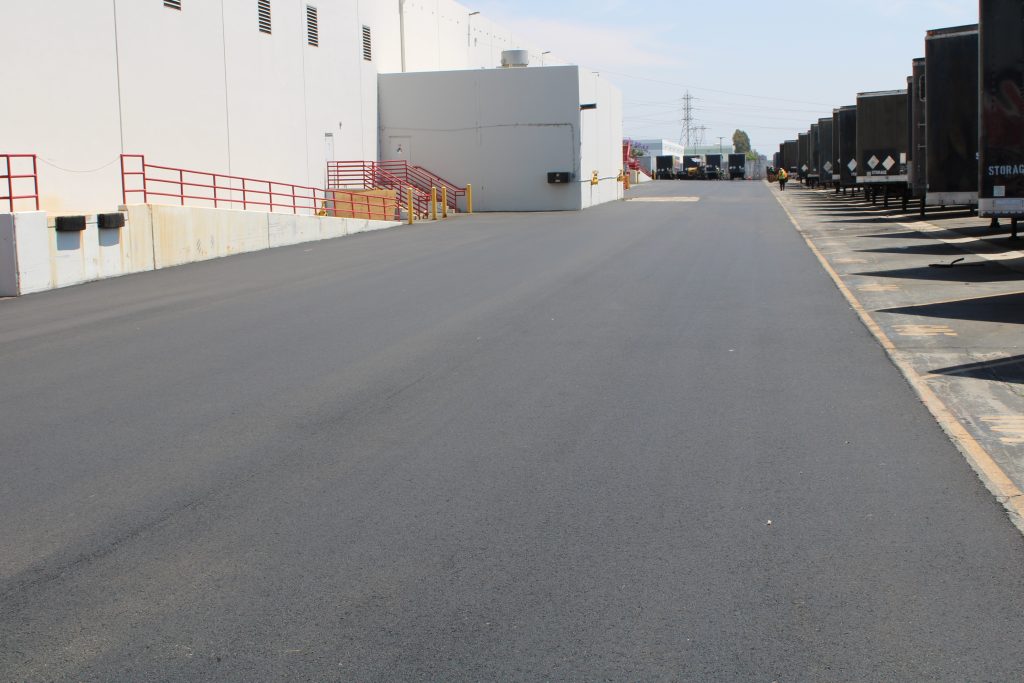
Drayage Yard & Truck Court Construction
Ground-up paving for the mesa’s working geometry — container and trailer staging fields, drayage yard circulation, cross-dock courts, and customs-lot queue lanes — with sections specified for legal-maximum loaded weights applied at walking speed, and written specs (thickness, base, mix, fiber-reinforced options) on every proposal, zone by zone.
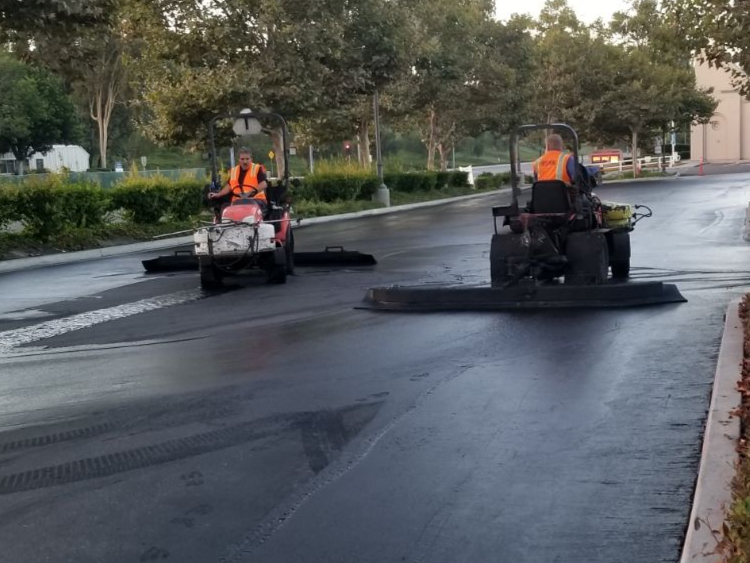
Removal & Replacement of Creep-Failed Pavement
Reconstruction of the mesa’s characteristic failures — deep ruts in queue lanes, mirror-image depressions across parking rows, shoved thresholds at dock approaches — rebuilt not to the original spec that failed, but to the duration-duty spec the traffic actually applies, with concrete graduated in at the true standing-load points (see [Concrete Installation & Repair in Otay Mesa] — internal link).
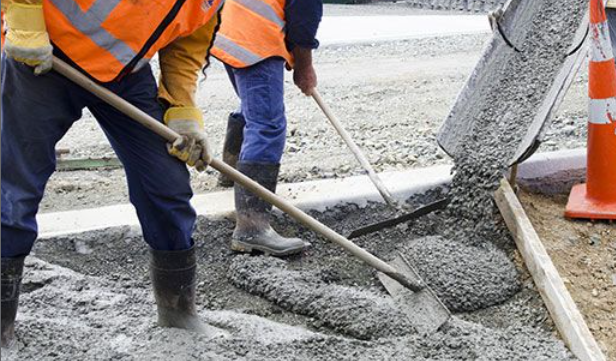
Fine Grading for Big, Flat, Working Ground
The mesa’s paradox: vast, flat logistics parcels where drainage has no gravity to borrow. Fine grading here is precision work at scale — engineered slopes across acres that move the December–March storms off working pavement without creating grades that fight trailer stability, dock levelness, or container stacking.
Permits and the San Diego System
Otay Mesa is a City of San Diego community, so right-of-way work — approaches to Otay Mesa Road, La Media, Airway, Siempre Viva, curb connections, anything in the public street — runs through the city’s Right-of-Way Permit system: plans to the San Diego Regional Standard Drawings, streamlined tracks for standard improvements, Traffic Control Permits with their five-working-day notification chain where the street is affected, and the citywide stormwater controls that keep construction runoff out of the Otay River watershed. Contractor scope, all of it — and on parcels this size, we run the permit clock in parallel with yard design so neither waits on the other.
Why Otay Mesa Property Owners Choose United Paving Co.
Licensed California Contractor
verify our license anytime through the CSLB license check.
Over 25 years in the asphalt and concrete industry
Serving properties from Los Angeles through San Diego County
Active members of the property-management community.
BOMA, IREM, CAI, ICSC, AGC, and more.
Materials and Methods
Free on-site written estimates
We work throughout the Otay Mesa community of San Diego — 92154 (the core industrial district: the Otay Mesa Road, Airway Road, and Siempre Viva corridors and the port of entry logistics blocks), 92179 (East Otay Mesa: the SR-11 corridor parcels toward the Otay Mesa East port site), and 92173 (neighboring San Ysidro to the west) — plus the SR-905/SR-125 corridor and Ocean View Hills. See our [service] pages for Miramar, Carlsbad, and Vista.
How a Quality Asphalt Paving Project Works, Step by Step
Most pavement failures trace back to shortcuts in the first three steps below — the ones buried underground when the job is “done.” Here’s the full process, so you know what to expect and what to ask any contractor bidding your project:
1. Site Evaluation & Soil Assessment
San Marcos sits on a mix of decomposed granite, sandy loam, and clay-heavy soils depending on where you are — and each behaves differently under load. Clay expands when saturated and shrinks when dry, flexing whatever sits on top of it. A contractor who quotes your project without evaluating the subgrade is guessing with your money.
2. Demolition & Excavation (for replacement projects)
Failed asphalt and contaminated base are removed and hauled off — and old asphalt is one of America's most recycled materials, routinely reprocessed into new pavement, as documented by the Asphalt Institute. We excavate to the depth the new pavement section requires, not just deep enough to hide the old problems.
3. Subgrade Preparation & Aggregate Base
The subgrade is compacted and proof-rolled to expose soft spots, which are dug out and rebuilt. Then Class II aggregate base is placed and compacted in lifts. This layer carries the structural load; the asphalt on top mostly protects it and provides the driving surface.
4. Fine Grading for Drainage
Surfaces are graded to a minimum slope (typically 1–2%) toward drains, gutters, and flowlines. Standing water after a storm is the most common visible symptom of grading that was skipped or done wrong.
5. Hot-Mix Asphalt Placement
Hot-mix asphalt arrives at roughly 300°F and must be placed and compacted before it cools. Thickness depends on use: a residential driveway section differs substantially from a truck-trafficked commercial lot. This is why a bid quoting "asphalt paving" without specifying compacted thickness isn't comparable to one that does.
6. Compaction & Finishing
Rollers compact the mat to target density while it's still workable. Proper compaction is the single biggest factor in pavement durability — under-compacted asphalt lets in air and water and ages years faster.
Otay Mesa Asphalt Paving - FAQS
Why do our queue lanes rut when the same trucks don't damage the circulation lanes?
Duration. The circulation lanes see each axle for a fraction of a second; the queue lanes hold the same axles for minutes at creep speed, over and over, down identical wheel paths. Same trucks, radically different duty — which is why the two zones need different sections, and why uniform-spec yards always fail in the queues first.
Can asphalt handle a trailer parking field at all, or should it be concrete?
Asphalt handles parking fields economically if it's specified for standing loads — stiff mixes, deep sections — with concrete dolly strips where landing gear concentrates tonnage on square inches. All-concrete fields are bulletproof but rarely pencil at mesa acreage; the hybrid is the working answer, and we draw the boundary on the load map.
Does summer heat really change what should be built here?
Materially — the mesa runs hotter and drier than the coastal cities, and heat-softened asphalt under standing loads is the exact recipe for the deformation this district is famous for. Mix selection for hot-service stiffness isn't an upgrade on Otay Mesa specs; it's the baseline.
How does the Otay Mesa East project affect paving decisions now?
Directionally, it argues for building to growth: the second port under construction to the east means the mesa's truck volumes are planned to rise, and yards built to today's marginal spec will meet tomorrow's traffic early. We'd rather owners hear that during design than during the first reconstruction.
Can a working drayage yard be repaved without stopping operations?
Yes — in phases drawn from the yard's own movement map: queue lanes rebuilt in halves overnight, staging rows rotated out of service section by section, and gate access preserved every hour of the project. On the mesa, the phasing plan is as load-bearing as the pavement.
What's the most common mistake on the yards you're called to fix?
A suburban parking-lot spec applied to border freight — pavement designed for cars and delivery vans, assigned loaded international trucks that stand on it. The fix costs what the original savings pretended to be; the lesson is in every ruined queue lane on the mesa.
Areas We Serve NEAR Otay Mesa
We work throughout the Otay Mesa community of San Diego — 92154, from the Otay Mesa Road and Airway Road industrial corridors to the La Media, Britannia, and Siempre Viva logistics blocks near the port of entry — plus the SR-905/SR-125 corridor parcels and neighboring San Ysidro and Ocean View Hills. See our asphalt paving pages for Miramar, Carlsbad, and Vista.