
Asphalt Paving in Oceanside, CA
Specified by the Mile, Phased for the People Living on It
Most paving jobs happen on empty pavement. Oceanside’s defining paving job happens on full pavement: apartment communities where every stall has a tenant, carports shelter the cars of families whose lease includes them, and the leasing office has move-ins scheduled through the month. Add the city’s span — salt-air blocks by the harbor, warm valley miles inland, industrial parks and corridor retail between — and paving here is two disciplines in one: engineering the right section for the property’s spot on the map, and choreographing the build around the people already using it. United Paving Co provides asphalt paving in Oceanside, CA with both disciplines in writing: new construction, removal and replacement, and fine grading, specified to the mile and phased to the lease calendar.
The Occupied-Property Playbook: Repaving a Community That Can't Leave
Here’s the problem no square-footage bid engages: an apartment community’s repave is a logistics project wearing an asphalt hat. Two hundred stalls means two hundred households whose cars must be somewhere else — but not all at once, and never for long. The playbook that works runs on five disciplines. Displacement math first: before any phasing is drawn, count the community’s real parking supply against its occupancy — the overflow areas, street parking legalities, and neighboring-lot agreements that will absorb each phase’s displaced cars — because a phasing plan without a displacement plan is a towing bill with a schedule. Small phases, fast cycles: occupied communities repave in more, smaller sections than commercial lots — each section demolished, based, paved, and reopened on the shortest achievable cycle, so no household’s displacement outlasts its patience. The communication cadence is infrastructure: notices at proposal-approved intervals, maps at every mailbox and door, dates that don’t move without notice, and a towing protocol coordinated with management so the one car that didn’t move gets handled by procedure instead of by crisis. Access hierarchies: fire lanes stay open every hour of every phase (non-negotiable and inspected), trash service and accessibility stalls are sequenced with their own continuity plans, and carports and garages — whose renters pay for them — get phase-specific access windows rather than open-ended loss. And the calendar respects the property’s own rhythm: in this city that means PCS season — the summer military move wave that fills leasing calendars — treated as protected territory, with major phases scheduled against the turnover peaks rather than through them. The bid-reading translation for owners and managers: a multifamily paving proposal should include the phasing map, the displacement plan, and the notice schedule as deliverables — a price without them is a plan to improvise on your residents.
Get Your Free Asphalt Paving Proposal
Our estimating and project management team will develop the right scope of work for your budget, performance goals, and visual expectations. Estimates and recommendations are free. Call (951) 739-9200 or submit the form below.
Your Pavement Maintenance Timeline
| When | What | Why |
|---|---|---|
| Year 1 | First seal coat (after full cure) | Locks in binder before UV oxidation starts |
| Every 3–5 years | Re-apply seal coat | Ongoing UV and moisture protection in our high-sun climate |
| Annually (fall) | Crack sealing | Closes entry points before winter rains reach the base |
| As needed | Patching, striping refresh | Addresses isolated damage; maintains ADA compliance |
| Year 15–25+ | Overlay or reconstruction | Even well-maintained pavement eventually reaches structural end-of-life |

Permits, the Oceanside Way: ROW/Beach Access, TCPs, and the Monument Rule
Work touching Oceanside’s public right-of-way — approaches, curb connections, anything beyond the property line the city warns you not to assume ends at the curb — runs through the Engineering Division’s Right-of-Way/Beach Access Permit, with a Traffic Control Plan supplementing wherever the work disturbs normal flow. Two details reward local fluency: excavation in the right-of-way triggers the Survey Monument Preservation Certification — the city protects its survey markers, and the contractor who documents before digging avoids the expensive version of learning that rule — and every permit gets an assigned inspector as the project’s single point of contact, a system that runs smoothly for contractors who treat the relationship as the asset it is. Larger projects add the familiar layers at city scale: haul route permits for demolition export, grading and erosion-control review where earth moves, and floodplain considerations for sites along the San Luis Rey corridor. All contractor scope on our projects, with the permit path — and the TCP, where one’s needed — identified at the estimate and scheduled in parallel with mobilization.
Our Asphalt Paving Services In Oceanside
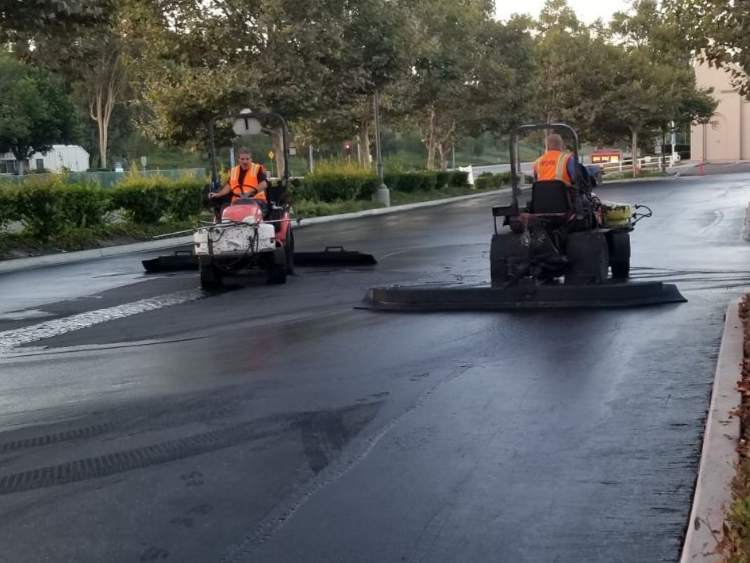
Multifamily & Portfolio Reconstruction
The Oceanside specialty: full removal and replacement at occupied apartment and condo communities — building-by-building phasing that never strands a resident overnight, displacement parking planned before demolition starts, carport and garage access sequenced, resident notices and towing coordination carried as scope, and move-in days ring-fenced on the schedule. For portfolio owners, multi-property programs priced and sequenced across the map.
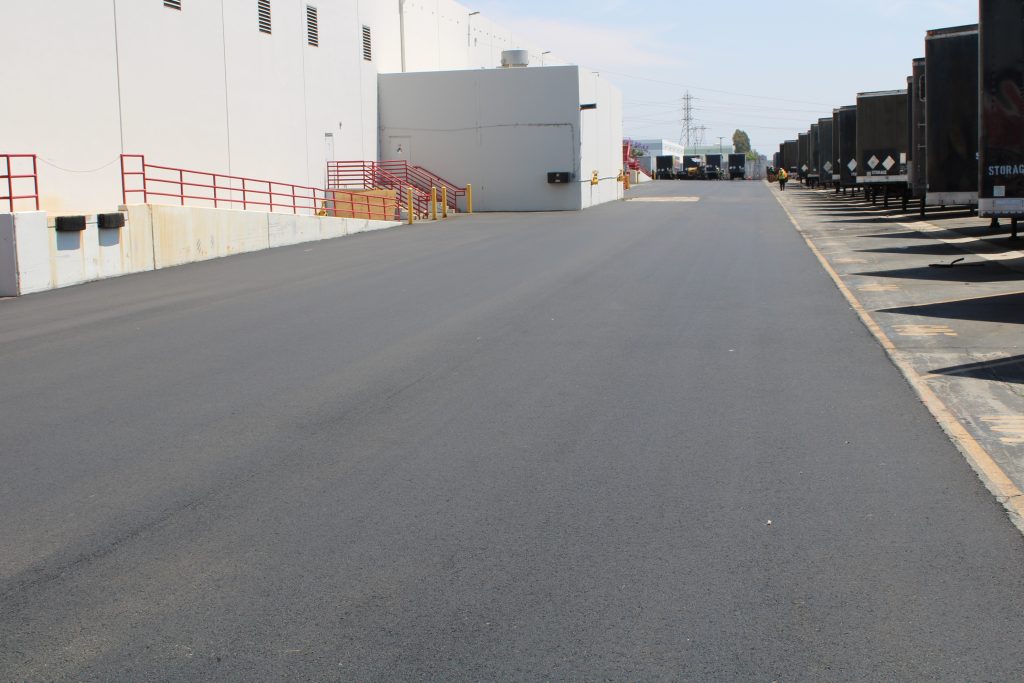
Commercial, Corridor & Industrial Construction
New pavement and reconstruction for Coast Highway and downtown’s revitalizing frontages, the retail corridors, and the industrial and corporate parks inland — zone-duty design where trucks work (courts and dock lanes specified heavier than stall fields, sections stated per zone), tight-site logistics where the corridor’s small parcels demand them, and tourist-season scheduling where the coastal blocks earn it.

Removal, Replacement & Fine Grading
Full-depth reconstruction where pavement is spent, engineered overlays where structure still serves, and grading that answers each property’s actual water problem — which in this city ranges from coastal lots that pond in flat sandy blocks to valley sites shedding real hillside runoff toward the San Luis Rey.
Coast Spec or Valley Spec: Designing to the Property's Mile Marker
Oceanside’s breadth makes “what should this pavement be built to?” a location question before it’s a traffic question — the same lot design specifies differently at the harbor than off College Boulevard, and honest proposals say which spec they’re writing. Near the coast, the design priorities tilt toward water management: drainage grades that never let the daily damp linger, compaction density treated as the moisture defense it is, joint and edge details sealed on schedule, and construction timing that respects gray-morning cure windows for every moisture-sensitive step. In the valley, the priorities tilt thermal: binder grades selected for sustained summer heat (soft-spec asphalt ruts and shoves where the thermometer lives higher), surface courses chosen for UV endurance, and maintenance cycles budgeted on the compressed inland clock from day one. In between — and much of Oceanside is in between — the honest answer is a judgment call made explicitly: we state the climate assumption on the proposal along with the traffic assumption, because a spec is only comparable when both are visible. The portfolio translation is where this earns real money: owners holding properties at both ends of town should expect their two proposals to read differently — and a bidder who hands the harbor property and the valley property the same boilerplate section has designed for neither.

Why Oceanside Property Owners Choose United Paving Co.
Licensed California Contractor
verify our license anytime through the CSLB license check.
Over 25 years in the asphalt and concrete industry
Serving properties from Los Angeles through San Diego County
Active members of the property-management community.
BOMA, IREM, CAI, ICSC, AGC, and more.
Materials and Methods
Free on-site written estimates
We work throughout Oceanside — 92054 (the coast: downtown, the harbor and pier districts, Fire Mountain, and South Oceanside), 92056 (central and east: the El Camino Real corridor, Rancho Del Oro, and the mesa neighborhoods), 92057 (the north and the San Luis Rey valley: College Boulevard corridor, Jeffries Ranch, and the route east), and 92058 (San Luis Rey and the Highway 76 corridor).
How a Quality Asphalt Paving Project Works, Step by Step
Most pavement failures trace back to shortcuts in the first three steps below — the ones buried underground when the job is “done.” Here’s the full process, so you know what to expect and what to ask any contractor bidding your project:
1. Site Evaluation & Soil Assessment
San Marcos sits on a mix of decomposed granite, sandy loam, and clay-heavy soils depending on where you are — and each behaves differently under load. Clay expands when saturated and shrinks when dry, flexing whatever sits on top of it. A contractor who quotes your project without evaluating the subgrade is guessing with your money.
2. Demolition & Excavation (for replacement projects)
Failed asphalt and contaminated base are removed and hauled off — and old asphalt is one of America's most recycled materials, routinely reprocessed into new pavement, as documented by the Asphalt Institute. We excavate to the depth the new pavement section requires, not just deep enough to hide the old problems.
3. Subgrade Preparation & Aggregate Base
The subgrade is compacted and proof-rolled to expose soft spots, which are dug out and rebuilt. Then Class II aggregate base is placed and compacted in lifts. This layer carries the structural load; the asphalt on top mostly protects it and provides the driving surface.
4. Fine Grading for Drainage
Surfaces are graded to a minimum slope (typically 1–2%) toward drains, gutters, and flowlines. Standing water after a storm is the most common visible symptom of grading that was skipped or done wrong.
5. Hot-Mix Asphalt Placement
Hot-mix asphalt arrives at roughly 300°F and must be placed and compacted before it cools. Thickness depends on use: a residential driveway section differs substantially from a truck-trafficked commercial lot. This is why a bid quoting "asphalt paving" without specifying compacted thickness isn't comparable to one that does.
6. Compaction & Finishing
Rollers compact the mat to target density while it's still workable. Proper compaction is the single biggest factor in pavement durability — under-compacted asphalt lets in air and water and ages years faster.
Oceanside Asphalt Paving - FAQS
Where do our residents actually park during a repave?
Wherever the displacement plan says — and that plan precedes the phasing plan: overflow areas mapped, street-parking legality confirmed, neighbor-lot agreements arranged where needed, and each phase sized so its displaced cars fit the available absorption. If a bid doesn't include the displacement answer, it's planning to discover it on your residents.
How long is each building's parking out of service?
Phases are sized for short cycles — typically days per section from demolition to reopening, with hot-mix trafficable quickly and cure-sensitive steps sequenced tightly. The phasing map in the proposal shows every section's window; the commitment is that no household's displacement runs open-ended.
Can you work around our summer move-in season?
We plan for it: PCS season's turnover wave is protected territory on multifamily schedules — major phases land in the shoulder months, and any summer work is sequenced to keep leasing tours and move-in days untouched. Tell us the leasing calendar and it becomes a scheduling constraint, not a casualty.
Do carport and garage renters lose access during the project?
They get windows, not open-ended loss: carport and garage rows are phased with their own access sequencing, notices tell each renter exactly which days affect them, and where a phase requires temporary relocation, the displacement plan assigns the alternative. Paid parking gets planned like the amenity it is.
What's the Survey Monument rule we've heard about?
Oceanside protects its survey markers: right-of-way excavation requires a Survey Monument Preservation Certification documenting nearby monuments before disturbance. It's a paperwork step for contractors who know it and an expensive surprise for those who don't — we carry it as standard scope on ROW work.
Our two properties sit at opposite ends of town. Should the specs really differ?
They should, visibly: the harbor-area property's proposal should lean drainage, moisture-defense compaction, and cure-aware scheduling; the valley property's should lean heat-stable binder and compressed maintenance cycles. Same owner, same service, different mile markers — and both climate assumptions stated in writing.
Areas We Serve NEAR Oceanside
We work throughout Oceanside — 92054 (the coast: downtown, the harbor and pier districts, Fire Mountain, and South Oceanside), 92056 (central and east: the El Camino Real corridor, Rancho Del Oro, and the mesa neighborhoods), 92057 (the north and the San Luis Rey valley: College Boulevard corridor, Jeffries Ranch, and the route east), and 92058 (San Luis Rey and the Highway 76 corridor). See our asphalt paving pages for Carlsbad, Vista, and San Marcos.