
Asphalt Paving in Corona, CA
Engineered for the Heat We Live In
Asphalt is a temperature-dependent material, and Corona is a temperature-serious town — which makes paving here an engineering conversation before it’s a construction one. Summer surfaces on the 91 corridor run hot enough to soften under-specified mixes exactly when the goods-movement trucks are working them hardest; the same sun ages every unprotected lot in the city on the fast clock. United Paving Co provides asphalt paving in Corona, CA the way a hometown contractor should: new construction, removal and replacement, and fine grading with the heat engineered in from the binder up, sections matched to what actually drives on them, and estimates informed by 25 years of knowing what’s under this city’s pavement — often because we put it there.
The Temperature Spec: What a PG Binder Grade Is, and Why Your Bid Should Name One
Here’s the piece of asphalt engineering every Corona owner deserves to know, because it’s the difference between pavement designed for this climate and pavement that merely arrived in it. The black glue holding asphalt together — the binder — is graded nationally on a temperature system: Performance Grades, written as two numbers like PG 64-10 or PG 70-10, where the first number is the highest pavement temperature the binder resists deformation at, and the second is the coldest it resists cracking at. The grades exist because binder behavior is temperature behavior — too soft for the local highs and pavement ruts and shoves under summer loads; too stiff for the local lows and it cracks in winter. The engineering standard, maintained by the industry bodies including the Asphalt Institute, selects grades from local climate data — and Inland Empire pavement temperatures argue for high-temperature grades that coastal-assumption bids simply don’t carry. The Corona compounding effect makes it matter doubly: heat and heavy loads multiply each other, because a binder near its high-temperature limit is softest precisely during the summer afternoons when loaded trucks are working the 91-corridor courts — which is why the classic local failure is seasonal rutting, wheel-path grooves that deepen each summer at gates and dock approaches while winter leaves them alone. The bid-reading translation is simple and powerful: a Corona paving proposal should name its mix and be able to state its binder grade — ours do — because “asphalt” without a temperature spec is like “steel” without a strength number, and in this climate the difference surfaces by the second July.
Get Your Free Asphalt Paving Proposal
Our estimating and project management team will develop the right scope of work for your budget, performance goals, and visual expectations. Estimates and recommendations are free. Call (951) 739-9200 or submit the form below.
Your Pavement Maintenance Timeline
| When | What | Why |
|---|---|---|
| Year 1 | First seal coat (after full cure) | Locks in binder before UV oxidation starts |
| Every 3–5 years | Re-apply seal coat | Ongoing UV and moisture protection in our high-sun climate |
| Annually (fall) | Crack sealing | Closes entry points before winter rains reach the base |
| As needed | Patching, striping refresh | Addresses isolated damage; maintains ADA compliance |
| Year 15–25+ | Overlay or reconstruction | Even well-maintained pavement eventually reaches structural end-of-life |
Estimating With a Memory: What Your Lot's Birth Decade Predicts
Twenty-five years of paving one city teaches something no soil report contains: Corona’s pavement problems run in generations, and knowing a lot’s era predicts what’s underneath before a core is drilled. The citrus-era and mid-century core — the Circle City grid and the older corridors — was built when section standards were lighter and truck traffic was unimaginable: lots here commonly carry thin original asphalt over minimal base, sometimes over the compacted remains of earlier uses entirely, and the estimating wisdom is to budget for the full conversation — overlay where the old structure still surprises us, honest reconstruction where sixty years have spent it, and no promises until the base has been read. The boom decades — the 1980s–2000s waves that built most of the city’s commercial stock — produced generally sound construction now reaching the age where maintenance history is destiny: two identical-vintage lots diverge entirely on whether anyone crack-sealed them, and the estimate hinges on what the last twenty winters were allowed to do. The master-planned south — Dos Lagos, Eagle Glen, and their neighbors — is young enough that builder-installed pavement is the story: engineered and documented, but built to development economics, which means HOA boards inherit streets whose sections we can often verify from records and whose future is a maintenance question, not a reconstruction one. The practical payoff of era-literacy: our Corona estimates arrive with the right questions already asked — and in a meaningful number of cases, with the original answers on file, because the contractor who’s worked a city for 25 years has paved, sealed, or repaired an awful lot of it before.
Our Asphalt Paving Services In Corona
Industrial & Commercial Construction
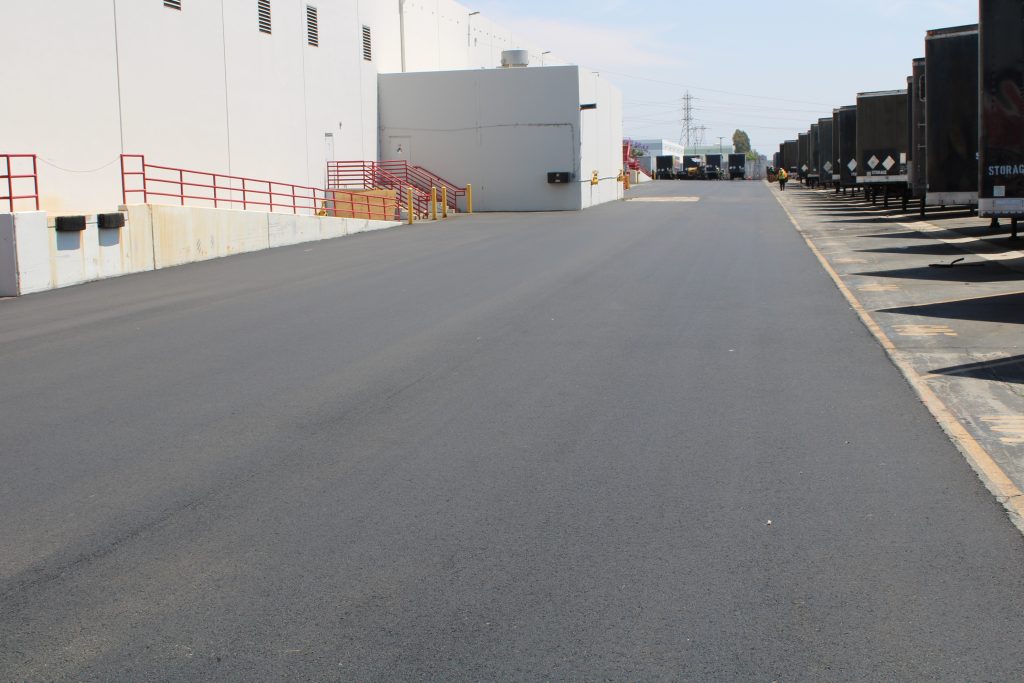
New pavement for the logistics and manufacturing parks of the north, the retail corridors, and the campuses between — zone-duty design as standard practice (truck courts and gate approaches specified heavier than stall fields, sections stated per zone in writing), heat-stable mixes as the baseline rather than the upgrade, and fiber-reinforced (Forti-Fi) options where braking and turning trucks work the surface hardest.
Removal, Replacement & Reconstruction
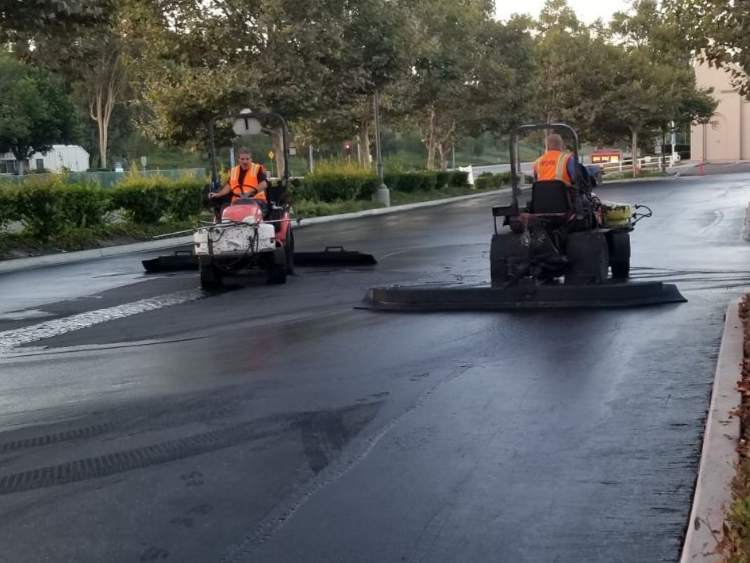
Full-depth rebuilds for the Circle City core’s aging lots and engineered overlays where structure still serves — scoped with the era-informed estimating below, phased so businesses and communities keep operating, and rebuilt to the duty that killed the original rather than the spec that failed. Encroachment permits for approach and frontage work run through the city’s Development Services counter as contractor scope.
Fine Grading & Site Work
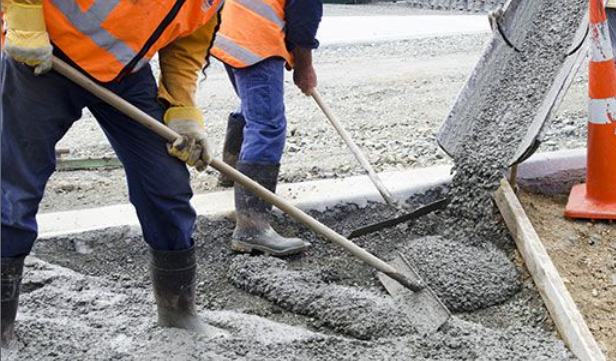
Grading for both of Corona’s terrains: the valley flats where drainage must be designed rather than inherited, and the westside hills — Sierra del Oro, Green River, the canyon edges — where slopes hand water real velocity and flat-lot habits fail. Erosion control built in per the city’s any-size grading ordinance, with state stormwater coverage handled where projects cross the acre threshold.
Paving in the Heat: Why Summer Is Our Season, and How the Work Changes
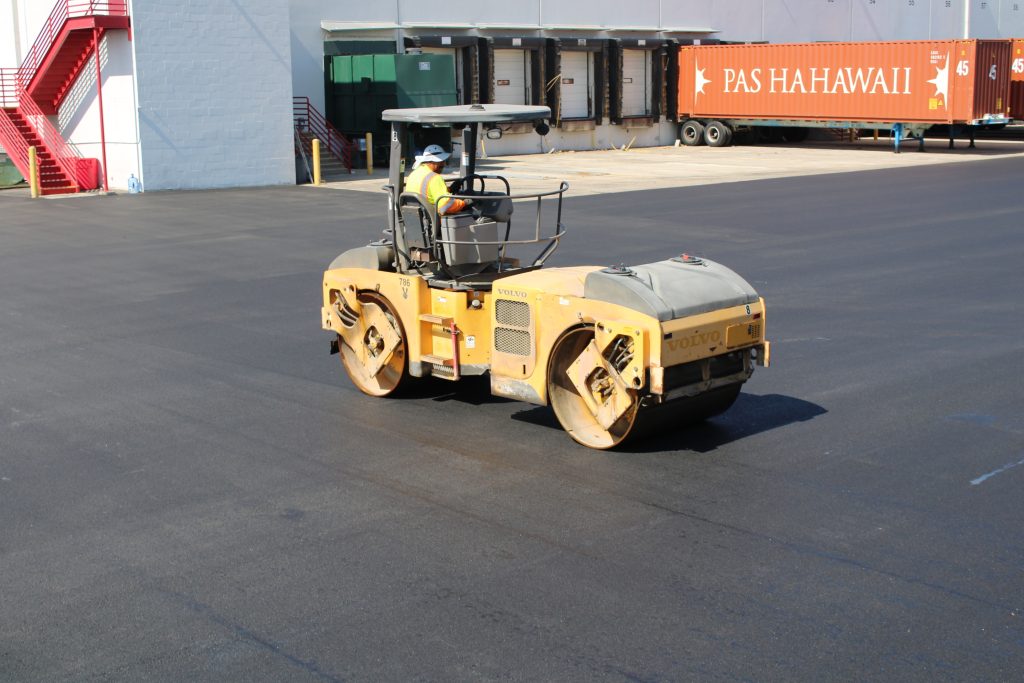
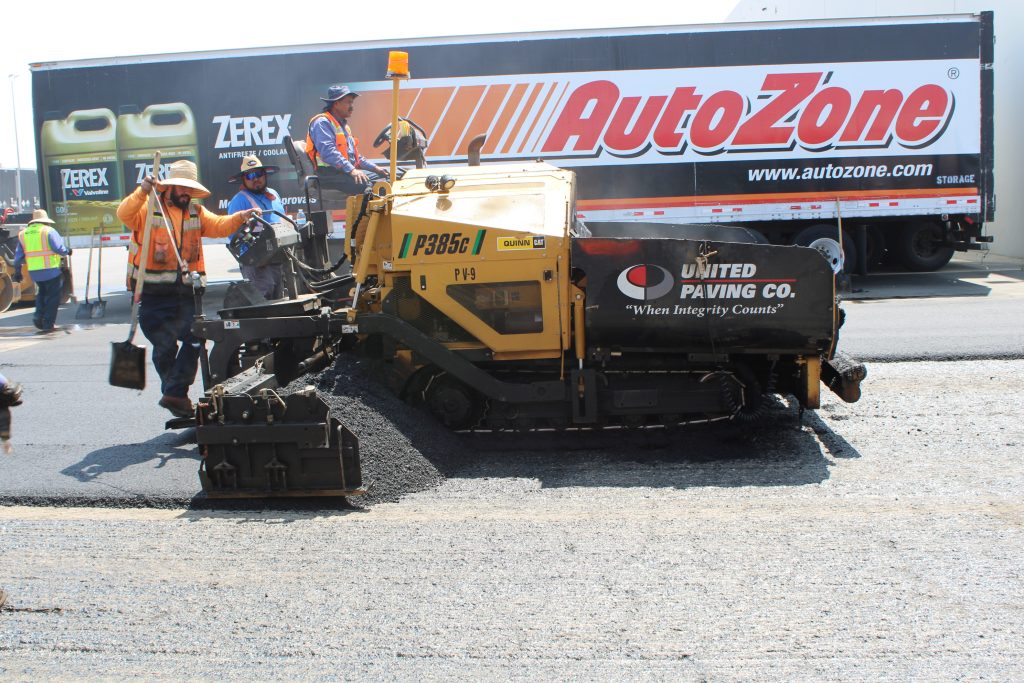
Hot-weather paving is its own craft, and Corona summers make us practitioners of it — worth understanding because it affects your project’s schedule and quality alike. Fresh asphalt arrives around 300°F and must be compacted to density before it cools below its working range: the compaction window is the whole game, because density is what pavement quality is — under-compacted asphalt lets in the air and water that age it prematurely. Heat plays both sides of that window. The advantage: hot ambient temperatures and hot ground slow the mix’s cooling, extending the window and letting rollers achieve density with margin — one reason inland summers are genuinely good paving weather and the season we schedule the year’s biggest work into. The management side: very hot mixes can go tender — a temperature zone where the mat shoves under rollers instead of densifying — which competent crews handle by rolling-pattern discipline and timing rather than hope; base and subgrade moisture flashes off fast, so moisture-sensitive steps run mornings; extreme-heat days shift crews early for the humans as well as the material; and large commercial pours on the 91 corridor often run as night work, where the mix still carries ample heat, traffic is thinnest, and businesses open on cured pavement. The owner’s translation: summer is not the season to avoid paving in Corona — it’s the season to insist your contractor knows how to use, which is a question one sentence answers: ask how they manage the compaction window in July, and listen for specifics.
Why Corona Property Owners Choose United Paving Co.
Licensed California Contractor
verify our license anytime through the CSLB license check.
Over 25 years in the asphalt and concrete industry
Serving properties from Los Angeles through San Diego County
Active members of the property-management community.
BOMA, IREM, CAI, ICSC, AGC, and more.
Materials and Methods
Free on-site written estimates
We work throughout Corona — 92879 (central: the Circle City core and North Main corridor), 92880 (the industrial north toward the Eastvale line), 92881 (the south: Eagle Glen, Dos Lagos, and the Ontario Avenue corridor), and 92882 (the west: Sierra del Oro, Green River, and the older westside neighborhoods) — plus the Temescal Valley communities of 92883, where county jurisdiction applies and we handle the difference as standard scope.
How a Quality Asphalt Paving Project Works, Step by Step
Most pavement failures trace back to shortcuts in the first three steps below — the ones buried underground when the job is “done.” Here’s the full process, so you know what to expect and what to ask any contractor bidding your project:
1. Site Evaluation & Soil Assessment
San Marcos sits on a mix of decomposed granite, sandy loam, and clay-heavy soils depending on where you are — and each behaves differently under load. Clay expands when saturated and shrinks when dry, flexing whatever sits on top of it. A contractor who quotes your project without evaluating the subgrade is guessing with your money.
2. Demolition & Excavation (for replacement projects)
Failed asphalt and contaminated base are removed and hauled off — and old asphalt is one of America's most recycled materials, routinely reprocessed into new pavement, as documented by the Asphalt Institute. We excavate to the depth the new pavement section requires, not just deep enough to hide the old problems.
3. Subgrade Preparation & Aggregate Base
The subgrade is compacted and proof-rolled to expose soft spots, which are dug out and rebuilt. Then Class II aggregate base is placed and compacted in lifts. This layer carries the structural load; the asphalt on top mostly protects it and provides the driving surface.
4. Fine Grading for Drainage
Surfaces are graded to a minimum slope (typically 1–2%) toward drains, gutters, and flowlines. Standing water after a storm is the most common visible symptom of grading that was skipped or done wrong.
5. Hot-Mix Asphalt Placement
Hot-mix asphalt arrives at roughly 300°F and must be placed and compacted before it cools. Thickness depends on use: a residential driveway section differs substantially from a truck-trafficked commercial lot. This is why a bid quoting "asphalt paving" without specifying compacted thickness isn't comparable to one that does.
6. Compaction & Finishing
Rollers compact the mat to target density while it's still workable. Proper compaction is the single biggest factor in pavement durability — under-compacted asphalt lets in air and water and ages years faster.
Corona Asphalt Paving - FAQS
What binder grade should Corona pavement actually use?
One selected for Inland Empire pavement temperatures — meaningfully higher on the heat side than coastal defaults — with the final call made from the site's traffic: heavy, slow trucks push the grade (and sometimes the mix design) further up the scale. The honest answer is a named grade on your proposal, not a shrug; if a bidder can't state theirs, they haven't chosen one.
Our gate ruts a little more every summer but stays stable all winter. What's happening?
The compounding signature: your binder is running near its high-temperature limit, so summer afternoons soften it exactly when loaded trucks work the gate — each hot season deepens the grooves, each winter pauses the damage. The fix isn't patching the ruts; it's rebuilding the trafficked zone with a heat-appropriate grade and a stiffer mix, once.
Is paving in July a bad idea here?
The opposite, done right: summer heat extends the compaction window that determines pavement density, which is why it's our heaviest construction season. The craft is in managing it — rolling discipline through tender zones, morning scheduling for moisture-sensitive steps, night pours for big commercial work — and the question that sorts bidders is exactly that: how do you manage the window in July?
We own a lot in the older core. What should we budget for that newer-lot owners don't?
The unknown underneath: older-era construction commonly means thin original sections and light base, so the honest budget carries a contingency for what the demolition reveals — and the honest bid says whether it's priced for overlay, reconstruction, or a decision made at the base. Era-informed estimating narrows the surprise; it can't erase it.
Can big projects on the 91 corridor run at night?
Routinely — night paving is standard practice for the industrial parks: the summer mix carries ample working heat after dark, corridor traffic is at its thinnest, and docks open in the morning on finished pavement. Street-closure and overload permits, where the work needs them, run through the city counter as our scope.
Is it true you might already have records on our property?
More often than you'd guess: 25 years of Corona work means a deep file of lots we've paved, sealed, or repaired — original sections, past repairs, what the base looked like last time it was open. Give us the address before the walk; sometimes the estimate starts with our own history.